

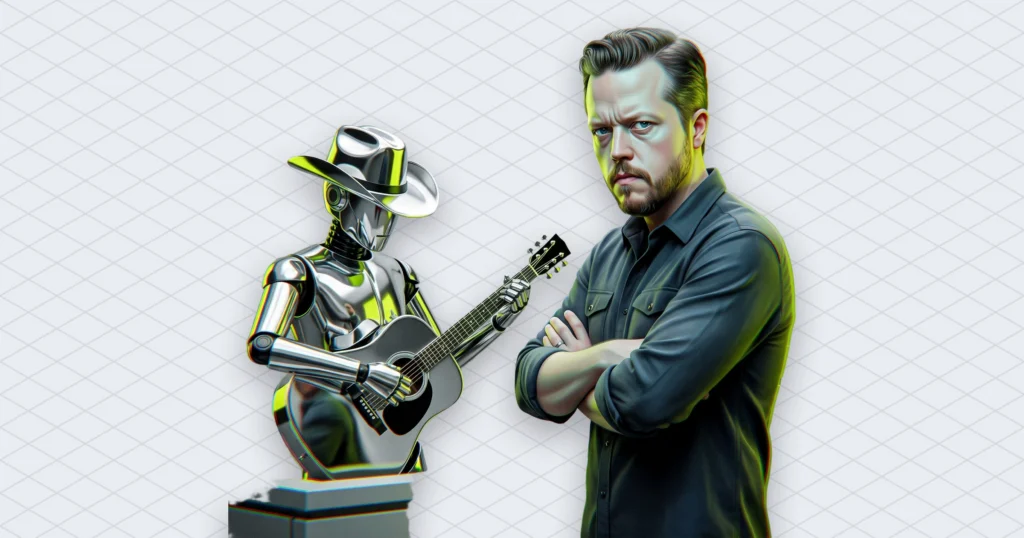
On Nov. 3, Suno asked a federal judge in Boston to throw out the Jason Isbell lawsuit. Four musicians filed that class action in August over AI songs made by typing an artist’s name into Suno. Suno’s argument fits on a napkin. Asking for “a Jason Isbell vibe” is how people have always described music, and the First Amendment protects it. Below you’ll find the full timeline, what each side says and what it means if you put real names into AI music prompts.

Suno asks a judge to dismiss the Isbell lawsuit on free-speech grounds
Suno’s motion, first reported by Billboard, says there is “nothing unlawful” about using an artist’s name to describe music. It asks the court to end the case now, before any trial.
The lawyers compare it to a studio session. A human producer can say “let’s go for something here with more of a Jason Isbell vibe.” Nobody sues. “When people describe styles of music, they often use artists’ names as shorthand for the genre they perform in,” the motion says. Suno says the Isbell lawsuit “turns on the premise that the law somehow condemns that universal practice.” Then comes the line the motion is built around: “In reality it does not; the First Amendment would not allow it to.”
MLex’s report adds two more lines from the filing. Suno says nobody could mistake its outputs for the plaintiffs. It also says that, going by the musicians’ own description of the service, “what Suno does … is no different” from a producer chasing an artist’s sound.
Suno also has a backup argument, called preemption. Under that doctrine, federal law overrides state claims that cover the same ground. Suno says copyright law leaves artistic style unprotected on purpose. Letting state likeness laws protect it would create “a shadow state law IP regime,” the motion says. That would clash with a federal system “in place for more than two centuries.” Isbell’s attorney did not immediately answer Billboard’s request for comment.
What happened so far in the Suno Isbell lawsuit
The case is about two months old. Suno’s motion is the defence’s first big move:
- Aug. 31, 2026: Jason Isbell, David Lowery (Cracker, Camper Van Beethoven), blues musician Guy Forsyth and saxophonist Eduardo Calle file the lawsuit against Suno in federal court in Boston. The complaint runs to 84 pages with 17 counts, per Music Business Worldwide.
- Sept. 1: Digital Music News reports the case number (1:26-cv-14005) and the claims. They cover publicity rights under Illinois, California and other states’ laws, plus a voiceprint claim under Illinois’s biometric privacy law (BIPA).
- Nov. 3: Suno files its motion to dismiss. Billboard gets it first, and MLex reports it the same day.
- Next: the musicians answer the motion in writing, then the judge rules. Nobody has reported a ruling date.
Suno already faces separate copyright suits from major labels over training data. We covered one turn of that fight when Suno subpoenaed Apple over its AI deal terms. The Isbell lawsuit against Suno contains no copyright claim at all.
The musicians say Suno indexes artists by name
At its core, the Isbell lawsuit claims Suno “built and trained a model to index musicians by name.” According to the complaint, Suno turned their identities into a product without consent. In its words, the platform is “built to identify musicians by name and generate identity-evocative output on command. This is its product.”
The headline example comes from MBW’s summary of the complaint. Typing “Jason Isbell” into Suno v5 produced an Americana track called “Paper Bell”. The filing says its vocals imitate his. A song named after a misspelled version of you. Hard to beat that for a first exhibit.
Suno says it does not accept artist names as prompts. When someone types one, the system turns it into “descriptive musical characteristics.” So “Duran Duran” might become “New wave, Synth-pop, Pop rock.” The musicians say spaces beat the filter, as in “t a y l o r s w i f t.”
(People used the same trick to sneak swear words past chat-room filters in 2004. It worked then too. Anyway.)
The suit seeks class status for what it calls potentially “millions” of artists. That is a big room. It also asks for damages and a court order that stops Suno using musicians’ identities without consent.
Why the outcome matters for anyone prompting AI music
If the judge throws out the Isbell lawsuit, Suno gets a court on its side of the argument. Big if. Typing a real artist’s name to describe a style would then look a lot like saying it out loud in a studio. If the case goes on, name-based prompting becomes a legal question for every AI music tool on the market.
Either way, this risk is different from the one creators usually check for. A copyright check asks whether a rights holder claims the track. A publicity claim asks whose name or voice the track trades on. No checker scans for that.
Copyright claims are common enough on their own. In Mubert’s own data, last 28 days, 25.5% of tracks run through our copyright checker came back with a rights holder’s claim, slightly down from 26%. That is about one in four, before anyone asks about voices.


Our take on the Suno Isbell lawsuit: style is free, a voice may not be
Suno’s strongest point in the Isbell lawsuit is about names as descriptions. Nobody should need a licence to say “sounds like early-2000s Nashville.” Copyright has never protected a genre either. Musicians have always built on each other’s styles, and Suno is right about that.
The motion is weaker on the part the complaint leads with: vocals. The musicians don’t call “Paper Bell” a vibe. They call it Isbell’s voice. Suno says otherwise, but that is a factual question, and a judge may want evidence before settling it. We are not lawyers (this post comes from people who own too many audio interfaces), so treat that as an opinion, not a forecast.
We have a stake in this debate, so read it with that in mind. Our generator composes from samples that artists upload and get paid for. That is a different supply chain from a model the complaint says indexes musicians by name. Sooner or later every AI music company will have to say where its sound came from. Some will have a shorter answer than others.
What to do before the judge rules
A ruling on the Isbell lawsuit could take months. Don’t wait for it. Do by hand what Suno says its filter does: describe the music, not the musician. “Warm americana, pedal steel, 80 BPM, road-trip vlog” gets you most of the way there. It also holds up better than spacing out the letters of someone’s name.
Never title, tag or describe a generated track with a real artist’s name. That is the part publicity laws care about most. Keep a copy of the prompts you used. And read the licence scope on your plan before you monetise anything, whichever tool made the track.
For the other half of the fight, see the label list of 60,202 tracks that allegedly trained Suno. That case is about recordings. This one is about whether “vibe” counts as a legal argument. Suno just bet a whole motion on yes.
Cover: illustration based on a photo of Jason Isbell by Bryan Ledgard from Yorkshire, UK, CC BY 2.0.

 Who we are


