
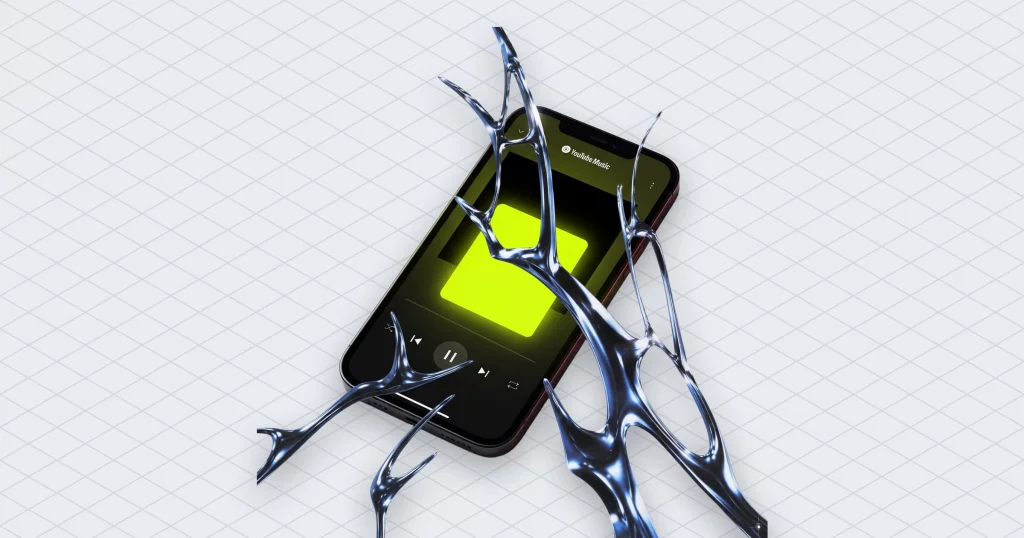
YouTube Music AI labels are live. Since October 14, songs made mostly with generative AI carry a small badge on the player page. If your music touched an AI tool at any point (a generated bassline, a prompted chorus, a whole song typed into a text box), this post covers which tier you fall into, what happens when you leave the form blank, and how YouTube compares with Deezer, Apple Music and Spotify.
Music Business Worldwide reports that the Google-owned platform announced the rollout on Wednesday, October 14. The labels target songs where generative AI did most of the work.


What YouTube Music AI labels actually mark
YouTube’s own example is a track where a generative model wrote both the composition and the vocals. So the badge covers the robot-wrote-the-whole-thing end of the scale, not the producer who once asked a chatbot to rhyme with “orange” and has felt slightly guilty about it ever since.
YouTube Music shows the AI label on the player page while the song plays. Tap it for details. Think of it as a nutrition label that only goes on the ready meals.
TechCrunch reports that YouTube will also bring these music AI labels to the main YouTube app. No date yet. YouTube also hasn’t said how many tracks it expects to label.
What happened so far
Every major streaming service has spent the last 16 months picking its own way to handle AI music:
- Jun 20, 2025: Deezer starts tagging albums with AI-generated tracks, partly to fight fraud (TechCrunch).
- Sep 25, 2025: Spotify says it will adopt DDEX, the industry’s metadata standard, to put AI disclosures into song credits, and it also announces a filter aimed at music spam (TechCrunch).
- Mar 2026: Apple Music announces AI transparency tags for labels and distributors (Music Ally).
- May 2026: YouTube starts detecting AI in videos and says a label alone doesn’t change reach or earnings (MBW).
- Aug 11, 2026: Spotify announces “AI Persona” badges for AI-generated artists (TechCrunch).
- Aug 20, 2026: Apple tells labels and distributors that music tagged under its transparency system will get a visible “Made With AI” label for Apple Music listeners later this year (Complex).
- Oct 13, 2026: Deezer announces a toggle that hides fully AI music from search (MBW).
- Oct 14, 2026: YouTube Music labels arrive.
The three tiers, and where Auto-Tune lands
The rules live on a YouTube Help page for music partners. Labels and distributors declare Gen AI use when they deliver content through DDEX or CSV templates. (DDEX is the standard metadata format the industry uses to send releases to stores.) Partners who upload in YouTube Studio can mark it there instead.
There are three tiers. Which one you pick decides what YouTube Music’s AI label says about your song. Fully Gen AI means generative AI made all of it. Partly Gen AI means it made some. No Gen AI means it made none.
Fully is the easy one. YouTube’s examples include typing a prompt into an AI music generator and downloading the result, and also refining the output over many prompts first. So prompting forty times still doesn’t make it handmade. We checked.
Partly is the big middle. YouTube lists an artist who generates a bassline or a string section, then adds live vocals and instruments. The examples even include a fully human-performed song whose music video came out of a text-to-video model.
Good news for engineers. The page files standard pitch correction (think Auto-Tune) and automated AI mastering under No Gen AI. It also leaves one thing loose: partners interpret the DDEX definitions for their own content.
Leaving the field blank is also an answer
Leave the field empty and YouTube Music can still put an AI label on the track. The Help page says YouTube may add its own signals to partner declarations. When a partner sends no Gen AI information at all, YouTube relies on those signals alone and may mark the content fully or partly Gen AI.
Android Central put it plainly: an empty disclosure field is no guarantee a song won’t get tagged. We couldn’t find anything public on what those signals are or how often they get it wrong. So if you say nothing, someone else’s detector speaks for you.
There’s a reverse gap. The announcement talks about songs made mostly with AI, and none of the coverage we read says clearly whether Partly Gen AI tracks carry the player label too.
The label does not touch money (as far as YouTube says)
This is the part artists care about most. YouTube is betting on disclosure rather than punishment. Storyboard18 reports YouTube’s position that AI in a track does not, by itself, rule the music out of monetisation, so a YouTube Music AI label is not a demonetisation notice.
On reach, the evidence is indirect. YouTube says it applies the same labelling principles it uses across the platform, and for video those principles say a label alone doesn’t change recommendations. But neither the Help page nor the launch coverage spells out whether labelled tracks get different treatment in recommendations or royalty payouts. So the honest summary is “no penalty announced”, which isn’t quite the same as “no penalty”.
How YouTube Music AI labels compare with Deezer, Apple Music and Spotify
Deezer is the strict one. It already pulls tracks it detects as fully AI-generated from algorithmic recommendations and editorial playlists. The company says nearly 90,000 fully AI-generated tracks reach it every day, and its hide-from-search toggle rolls out globally before the end of 2026. Some of that pressure comes from fraud, which has started costing people real prison time.
Tidal goes further on money. In June it said it would tag fully AI-generated music and stop paying royalties on it, as TechCrunch recaps.
Apple Music relies on self-declaration. Labels and distributors must tag a release when AI created “a material portion” of the track, composition, video or artwork, and the visible label will follow those tags. One threshold, no tiers.
Spotify labels the artist, not the audio. Its “AI Persona” badges mark profiles of AI-generated identities, and Spotify keeps their music out of recommendations by default. AI credits cover how the track was made.
Next to these rivals, YouTube Music AI labels sit in the middle. YouTube runs detection like Deezer and asks for declarations like Apple, but it hasn’t announced any hit to your reach or revenue.
What we think about AI labels on YouTube Music
The three tiers are the smart bit of the YouTube Music AI labels. A model-made bassline and a song typed into a prompt box are different things, and a single “AI” sticker treats them as one.
The weak bit is who does the sorting. The people selling the songs decide what counts, and a detector nobody has audited checks their homework. A label is only worth the classification behind it.
A confession, since this concerns us directly: we build a generative music platform. Mubert composes tracks from samples that human artists upload and get paid for, so “where did this sound come from” is a question we’d rather answer than dodge. Labels like this are fine by us. (The vague ones bother us.)
Small tangent. Somewhere a mastering engineer has spent a decade explaining that their AI mastering plugin is “just a compressor with opinions”, and as of this week YouTube agrees in writing. Anyway.
What to declare before YouTube Music labels your AI track
- Ask your distributor or label whether it sends the Gen AI field to YouTube, and which value.
- List every AI tool per release.
- Pick Fully when a model wrote the composition and vocals, however many prompts it took.
- Pick Partly when generated layers sit under your own live performance.
- Count AI visuals too, because YouTube’s own examples show that an AI-generated music video can move an entirely human-performed song into the Partly tier.
- Leave standard pitch correction like Auto-Tune and automated mastering out, since YouTube files both under No Gen AI.
- Keep project files and stems in case the detector disagrees with you.
The ready meals on YouTube Music now come with an AI label. Make sure yours lists the right ingredients before the detector writes the list for you.




 Who we are