

The Tidal AI music ban starts on December 9, 2026. From that day Tidal rejects any track it decides is 100% AI-generated. It is also deleting the ones already there: about 27 million tracks, 6.3% of the service, says Tidal’s own announcement. If you release music from Suno, Lyria or another generator through a distributor, this post is for you. It covers what “fully AI” means here, what happens to existing releases and what to check before the date.
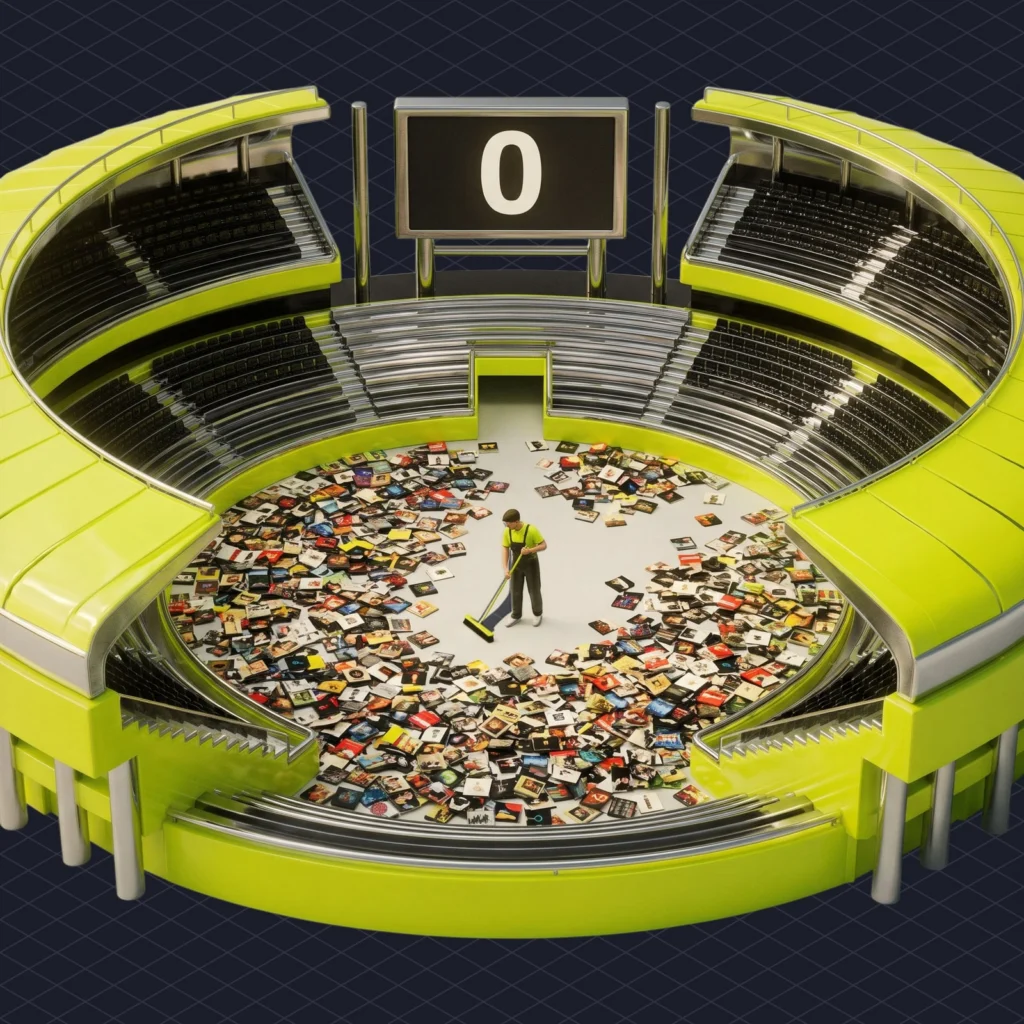
Some context for the size of the cut. Tidal says 96% of those tagged tracks got zero streams in the last three months. So most of the purge deletes songs that nobody played, like clearing out a stadium that was already empty.
The Tidal AI music ban starts December 9 and only covers 100% AI tracks
The rule fits in one sentence. “Starting December 9, any wholly AI-generated track that’s submitted to Tidal will be rejected and removed from our platform,” the company wrote, and it added that “tracks that were assisted by AI tools, but not the sole outputs, will be allowed.”
The reason is volume. Over the past 90 days, 43% of all tracks delivered to Tidal were wholly AI-generated. On November 6, the share passed 60% in a single day. TechCrunch reports that Tidal expects the AI music ban to reject 80,000 to 85,000 tracks a day once it takes effect. Tidal lead Robert Andersen told TechCrunch that demonetizing alone was not enough: “Something more drastic needs to be done.”
On the count: Tidal’s post says “approximately 27 million” tagged tracks. TechCrunch and Futurism write that more than 29 million will go by the end of the year. That figure includes tracks still arriving. Use 27 million when you mean what is on Tidal today.
What happened so far
All dates are 2026.
- January 13: Bandcamp bans music made “wholly or in substantial part” by AI (Engadget).
- June 29: Tidal stops paying royalties on fully AI music (Music Business Worldwide).
- July 15: an “AI” badge appears for listeners, and impersonation tracks start coming down.
- October 19: Tidal last updates its AI policy page.
- October 20: Spotify says it kept over 50 million spam tracks out of recommendations (Digital Music News).
- November 6: more than 60% of the day’s deliveries to Tidal are fully AI.
- November 24: TechCrunch and MBW report the ban; Tidal’s post is dated November 25.
- December 9: the Tidal AI music ban takes effect for new deliveries.
- By year-end: the catalogue deletion should be finished, per TechCrunch.
What counts as fully AI under the Tidal AI music ban
Fully AI means a person typed a prompt and the generator did everything else. That is how Seoul Economic Daily, citing The Verge and TechCrunch, describes what the Tidal ban on AI music targets. If a human wrote, played, arranged or produced a real part of the track, Tidal calls it AI-assisted and keeps it.
The ban runs on two checks. The first is detection from Ircam Amplify, the commercial arm of the French research institute IRCAM. Its CEO Nathalie Birocheau told Music Business Worldwide that the false-positive rate is below 0.02%. The second is metadata. Tidal will reject any delivery “if their metadata says they were generated solely using AI tools,” so the form you filled in at your distributor now decides the outcome.
A real example shows where the line falls. The Korean track that hit No. 1 on Melon had human planning, lyrics and production, and only the vocals came from Suno (our write-up of that case). Under Tidal’s wording that is AI-assisted, so it stays. In Korea, the same song still collects no songwriting royalties. Same track, two countries, two answers.
Tracks already on Tidal earn nothing now and should be gone by year-end
If Tidal has tagged your track as fully AI, it has earned nothing since June 29 and it is now on the removal list. Tidal says it is “removing all tracks that we determine are 100% AI generated”, and TechCrunch puts the finish line at the end of the year.
None of the sources describe an appeal process for the Tidal AI music ban. Neither the announcement nor the policy page mentions one, and no outlet we read does either. (A detector with a 0.02% error rate, run across tens of millions of tracks, still gets a lot of them wrong in absolute terms. Someone will want to dispute a result, and there is no published way to do it yet.)
The policy page also says Tidal plans to extend the AI tag to “substantially” AI-generated music as detection improves. So today’s line can move.

How the Tidal AI music ban compares with Bandcamp, Deezer, Spotify and SoundCloud
Tidal is the first major streaming service to ban fully AI tracks outright. Bandcamp got there first in January, but it is a store and distribution platform more than a streamer. Its wording is actually stricter: “wholly or in substantial part” covers more than Tidal’s “100%”.
Deezer tags AI tracks and keeps them out of recommendations and editorial playlists. It also deletes tracks used for streaming fraud or left unstreamed for six months, and it has detected more than 42 million fully AI tracks since January 2025, according to MBW. Still, it has announced no ban. Its own survey with Ipsos found that 41% of listeners want to filter out fully AI songs (we compared that with UMG’s much bigger number in this post on the AI kill switch).
Spotify handles it as a spam problem. It pulled more than 50 million tracks from recommendations this year rather than deleting them. On November 17 it also added a profile protection feature against impersonation uploads, Seoul Economic Daily reports. SoundCloud tightened its rules the same day, RouteNote reports: payouts tied to AI abuse can be withheld or clawed back, and heavy uploaders can face limits. It also stopped short of a ban, so the Tidal AI music ban remains the strictest rule among the big streamers.
What we think: deleting the tracks is easy, the detector is the hard part
The Tidal AI music ban deletes 27 million tracks, and 96% of them had zero streams in three months. So it hurts almost nobody who was making money. The demonetization in June already took care of that. What December 9 actually changes is that a classifier and a metadata field now decide if you get on the service at all.
We make a generative music tool, so we read this one three times, slightly annoyed. Mubert Render composes tracks from samples that real artists uploaded and get paid for. That supply chain is the reason we think the “fully AI or not” question matters. But we also think “a human touched it” has to mean something you can show, and Tidal hasn’t published that test.
Anyway. The metadata rule has an odd side effect. A distributor that honestly labels a track as fully AI gets it rejected automatically. A vague label at least gets a pass through the detector. Platforms will need to fix that incentive before honest labelling starts to look like a mistake.
What to do before the Tidal AI music ban starts
- Check your distributor dashboard for any release flagged as “AI-generated” and read the exact wording.
- Correct the metadata on AI-assisted releases so it doesn’t say “solely” AI, as long as that is true.
- Keep project files, stems and session notes that show your human part of each track.
- Pull or move releases that really are prompt-only before Tidal deletes them, and keep a copy.
- Look at your Tidal earnings since June 29: if a track went to zero, it is probably tagged.
If your track is sitting in that empty stadium, December 9 is when the Tidal AI music ban switches off the lights. If you put real work into it, get the evidence ready before you need it.




 Who we are