


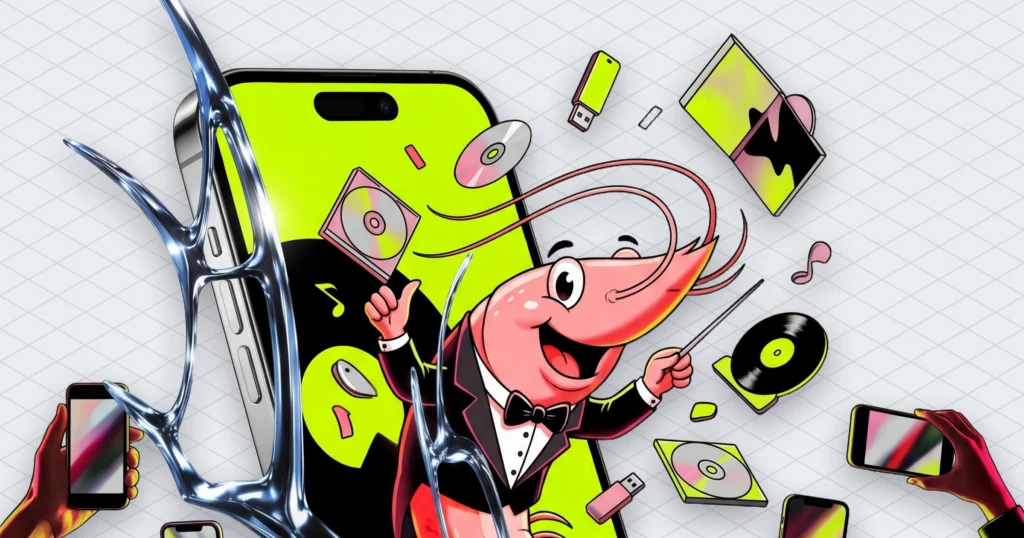
Alibaba HappyShrimp is an AI app that writes a song’s lyrics, melody, arrangement and vocals from one text prompt. Alibaba put HappyShrimp on Apple’s App Store and the major Android stores on November 13, 2026 (BigGo Finance). In mainland China, standard membership costs about 30 yuan a month (roughly NT$150) for 150 songs. Abroad it starts at US$14.90. If you’ve been comparing Suno and Udio for your videos, you now have a third tab to open, and this post covers the timeline, the prices, the licence fine print and what to check before you give a shrimp your card details.


Alibaba HappyShrimp launched on phones on November 13
The phone app is the second release. Alibaba first released HappyShrimp as a PC web beta on August 17, 2026, in China and overseas at once. Alibaba’s ATH (TokenHub) business group built it (AIbase). The App Store build is already at version 0.2.14. Zero point two. That version number openly admits the app is still new.
HappyShrimp is the third product in Alibaba’s “Happy series”, after the video model HappyHorse and the 3D video model HappyOyster. So the naming went horse, oyster, shrimp. No follow-up questions.
The shrimp has a history, though. The Chinese name echoes Xiami, the music streaming service Alibaba bought in 2013 and shut down in February 2021 (TMTPost). Xiami was known for discovery features and for supporting independent artists, and it still lost to rivals with bigger catalogues, which is roughly how most well-liked streaming services end. Five years later the brand is back. This time it writes the songs instead of playing them.
Anyway.
What happened so far
- 2013: Alibaba acquires Xiami Music (TMTPost).
- February 2021: Xiami shuts down.
- August 17, 2026: HappyShrimp 1.0 opens as a PC web beta in China and overseas, with free trial credits.
- Same day: Alibaba HappyShrimp signs a strategic partnership with Taihe Music Group, covering co-creation with musicians.
- November 13, 2026: iOS and Android apps launch with paid membership (BigGo Finance).
How HappyShrimp makes a song from one prompt
Type a prompt, get a song. You describe a genre, a mood or a story, and the model returns a finished song with vocals. According to BigGo, most tools write lyrics, melody and arrangement as separate steps and then stitch them together, while Alibaba HappyShrimp treats music as a language and plans the whole song, long-range structure included, in one pass. The styles listed at the beta launch include Chinese-style music, pop, R&B, hip-hop, rock, funk, electronic, classical and jazz.
The app has two modes. “Smart Lyrics” writes the words for you, or you can paste in your own lyrics. “Instrumental” makes music without vocals. AIbase pitches it as background music for short videos, podcasts and documentaries. That’s the creator mode.
Two more features stand out. “Music Recipe” saves your generation settings so you can reuse them. “Make a Similar Track” follows the style and instrumentation of an audio file you upload. AIbase says it does not copy the original singer’s voice. So it copies the feel of a song and stops at the voice. That is where legal trouble usually starts.
None of the launch coverage says how long a song can be. We looked.
The Alibaba HappyShrimp price: about 30 yuan for 150 songs, US$14.90 abroad
Alibaba HappyShrimp’s standard membership in mainland China costs about 30 yuan a month and covers 150 songs. That’s about 0.2 yuan per song. Overseas, membership starts at US$14.90 a month and credit packs at US$9.90, which BigGo converts to roughly NT$490 and NT$330, so on its own conversions an overseas member pays more than three times the mainland rate.
The credits expire. Each kind has its own clock. HappyShrimp’s paid-service terms say subscription credits last 31 days, daily login credits last 24 hours, and purchased credits last 365 days. No refunds once bought. Upgrade, and you lose the credits left on your old tier.
150 songs a month is also far more than most creators use. Mubert’s own data, last 28 days: creators who generated music with our Render tool made 3.9 tracks each. That’s a different tool and audience. Still, someone scoring videos usually needs a few good tracks, not a new album every week.


The HappyShrimp licence: commercial use for paid members, and a permanent one for HappyShrimp
The commercial rights depend on your plan. Under the paid-service terms, Standard and Professional members can use the generated music commercially. Free-tier users are limited to non-commercial use. So a free-credit song on a monetised channel is exactly what the free tier excludes.
Ownership comes with conditions. You hold rights in the generated work “to the extent permitted by applicable laws”. The Alibaba HappyShrimp terms also say the ownership split may be adjusted. You also give HappyShrimp a perpetual, irrevocable, worldwide, royalty-free, non-exclusive licence to your content and to what you generate. Read that twice. The contract is with Sleepless Horizon Technology Private Limited and its affiliates, which is the name to look for when you read the terms, file a complaint or wonder who exactly holds your chorus.
Then there is the training data. None of the launch reports we read says what the model learned from. The Taihe partnership brings a rights holder into the project, and AIbase presents that as a copyright strategy different from old Xiami’s. A partnership is not a list of training data. Creators should know the difference.
What Alibaba HappyShrimp means next to Suno and Udio
The main difference is who is behind it. BigGo names Suno and Udio as the international players built around fast song generation. Several Chinese platforms joined the race this year too. A company of Alibaba’s size can charge 0.2 yuan a song for much longer than a startup can, and BigGo calls Alibaba HappyShrimp a test of whether the company can sell AI to ordinary people as a subscription.
The two US rivals have spent 2026 dealing with lawyers. AIbase notes that Udio is building a licensed platform with Warner Music. Suno is still being sued, most loudly by Eminem’s publisher, which wants $41 million. HappyShrimp signed a label partner on launch day. It has said much less about its training data.
Our view: the price will make people try it, and the app looks easy to use. The licence is the weak part. Commercial use depends on keeping a paid plan. Ownership can be “adjusted”, and HappyShrimp keeps a permanent licence to everything you make. For a hobby song, none of that matters. If the music goes on a monetised channel or into a client ad, it matters a lot. We once used a track on a client video before reading the licence closely, found out it was stricter than we’d assumed, and cut the music out the night before delivery. Long night.
For another big company’s ownership fine print, see our breakdown of Google’s song studio.
What to do before you pay
- Generate one instrumental on the free credits and listen to it at the length you actually need.
- Read the paid-service terms and the main Terms of Service, especially the parts on ownership and commercial use.
- Keep free-tier songs off monetised uploads.
- Screenshot your plan and the date for every song you publish, since commercial rights depend on membership.
- Use your purchased or subscription credits before they expire (31 days for subscription credits, 24 hours for daily login credits).
Horse, oyster, shrimp. Whatever animal Alibaba names after HappyShrimp, read its terms before you pay.




 Who we are


