


Synthwave is electronic music that sounds like a 1980s action film soundtrack, made decades later. Its other name, outrun, comes from Sega’s 1986 arcade game Out Run. Its big break came with the 2011 film Drive. This post covers synthwave history in a handful of dates, then shows how to make a track from four sounds: a chorused synth, an arpeggio, drums that stop dead and a bass that never takes a break.
The short version: synthwave is nostalgia for a decade most of its producers were too young to remember. Not a criticism. It is the whole point, and it explains why the genre sounds so sure of a past that mostly existed on VHS covers, rental shop shelves and the back seat of somebody’s dad’s car.
Synthwave borrowed its other name from a 1986 Sega driving game
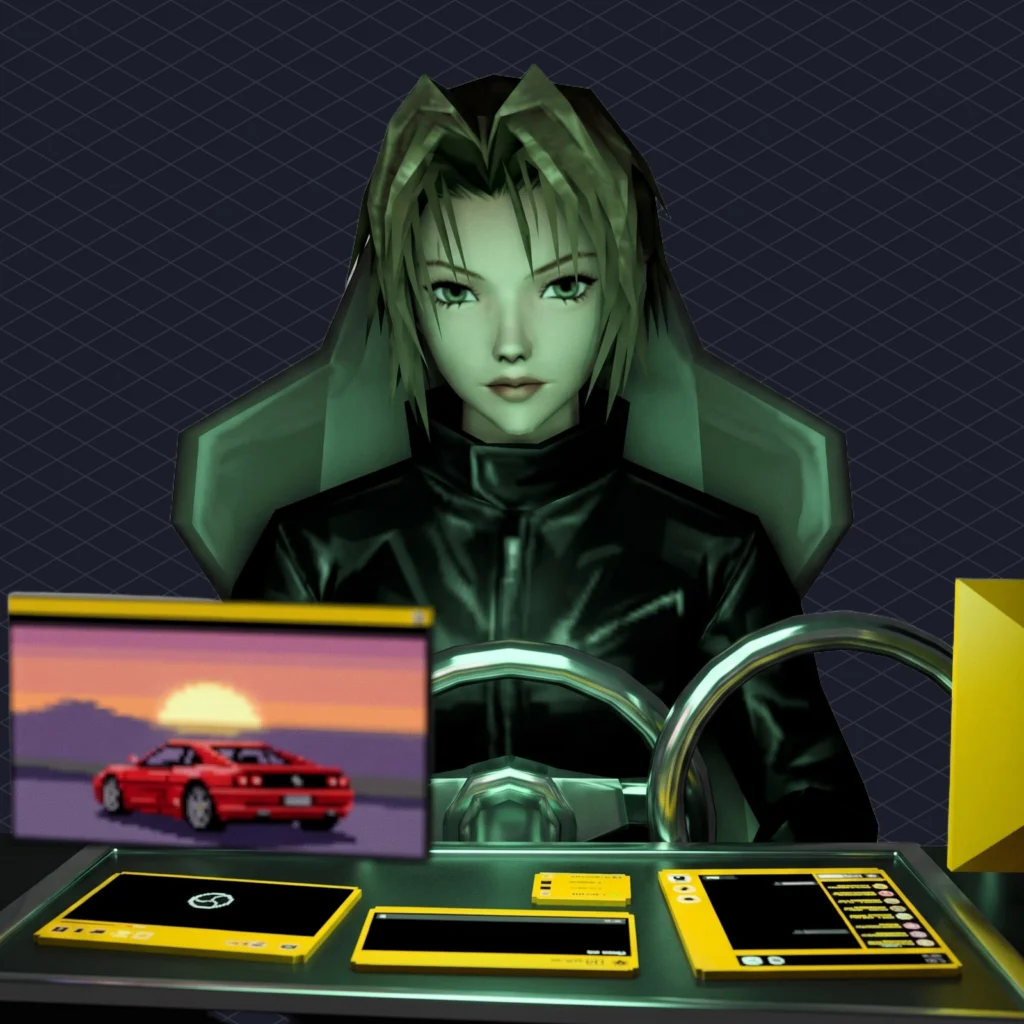
Out Run reached arcades in 1986, and it gave synthwave its second name. Yu Suzuki designed it. You drove a red Ferrari Testarossa convertible down sunny roads with a passenger beside you, which in 1986 counted as the complete fantasy. Suzuki found his hero car in Monte Carlo, according to Hagerty’s history of the game, at the end of a scouting trip that ran through Bavaria and France down to Monaco. The artist Hiroshi Nagai, the one who painted all those pools and palm trees, also shaped the look.
Suzuki first planned to drive from California to Florida. Sega sent him to Europe instead. He got a superior to keep an eye on him and a video camera to film it all. A road trip with a chaperone. Peak 1980s management.
Anyway.
The game’s sunsets, palm trees and red car became the genre’s visual kit, and when producers later wanted a name for the instrumental, nostalgic, driving end of synthwave, they simply took the game’s. Kavinsky went further and called his 2013 debut album OutRun. Roughly like a folk singer naming a record after a tractor.
A French synthwave single became part of a film soundtrack in 2011
Kavinsky released Nightcall in 2010, and a year later it was on the soundtrack of Drive. Nicolas Winding Refn directed the thriller. Ryan Gosling drove. The same album carried A Real Hero by College featuring Electric Youth, which KCRW called the soundtrack’s biggest revelation, and Cliff Martinez wrote the score around those songs.
Before Drive, synthwave mostly lived online, among people who already knew what a vocoder was. A vocoder makes a voice play a synth. Hence the robot vocal on Nightcall. After Drive, cinema audiences who had never heard the word walked out of the film humming a song sung partly by a machine, and the niche suddenly had a mood board everyone recognised. Night. Neon. A man in a satin jacket saying nothing.
Kavinsky, whose real name was Vincent Belorgey, died in July 2026, aged 50. Two years earlier he had played Nightcall at the closing ceremony of the Paris 2024 Olympics, joined by Angèle and Phoenix on 11 August at the Stade de France. Shazam then said it had become the most Shazamed song in a single day. Fourteen years after release. Few synthwave songs get a second life that big.
Games, Stranger Things and The Weeknd kept synthwave on screens
After Drive, synthwave spread through games, then television, then the top of the pop chart. In 2013 the Australian duo Power Glove scored Far Cry 3: Blood Dragon, and a review on bit-tech called the soundtrack probably the best part of the whole production. This is a game where you fight cyborgs. High praise.
Television came next. Kyle Dixon and Michael Stein of the Austin band S U R V I V E wrote the Stranger Things theme, which won the Emmy for Outstanding Original Main Title Theme Music in 2017. It also shows how little a hook in this genre needs. A Splice recreation of the theme puts it at 84 BPM in E minor, with the main line arpeggiating a C major 7th chord. One chord. One pattern. A filter that slowly opens. Basically a dripping tap that won an Emmy.
Then the sound reached the charts. The Weeknd’s Blinding Lights is a synth-pop song built on the same 1980s palette, and in November 2021 Billboard ranked it first on its Greatest of All Time Hot 100 Songs chart, ahead of Chubby Checker’s The Twist. It spent 90 weeks on the Hot 100, a chart that started in 1958. A sound that began as a joke about VHS covers now tops the whole list.
The synthwave sound rests on four ingredients
Most synthwave tracks stand on four parts: a chorused polysynth, an arpeggio, gated drums and a steady bass. Everything else is decoration, from the saxophone solo to the vocoder to the tape hiss somebody added on purpose. Get the four right. The track already sounds like a car commercial from 1987.
A polysynth with chorus, the Juno-60 way
A polysynth plays several notes at once, so it can hold chords, and Roland’s Juno-60 is the model most people point to. Roland’s own history dates it to 1982: six voices, one oscillator per voice, a syncable arpeggiator and a stereo chorus. That chorus makes the sound. It copies the signal, delays and wobbles the copies and spreads them left and right, so six voices end up sounding like a small, slightly tipsy orchestra. Roland itself calls its warm, noisy character “a sought-after trait”.
You don’t need the hardware. Any synth with a chorus effect gets you most of the way, and two oscillators slightly detuned from each other do the rest. When the pad sounds a little seasick, it is right.
Keep the attack slow and the release long, so chords swell in and hang in the air. A sharp attack sounds like a church organ in a hurry.
The arpeggio does the driving
An arpeggiator takes a chord you hold down and plays its notes one after another in a fixed rhythm. A riff on autopilot. That pulse does the job a guitar riff does in rock, moving the track forward while everything else sits still. Stranger Things is the textbook case: one chord, cycled for the whole intro, while a filter slowly opens.
So hold a chord. Set the arpeggiator to eighth or sixteenth notes. Then automate the filter cutoff, the knob that makes a sound darker or brighter, over 16 bars. That slow opening is half of what people call atmosphere.
Modes matter too. Up is the classic, up-down sounds more restless, and random sounds like a cat on the keys. Try an octave range of two, so the pattern climbs and falls instead of circling in place like a screensaver.
Gated reverb drums, the snare that stops dead
The big 1980s snare came from an accident. Engineer Hugh Padgham told the story in a MusicTech interview: the new SSL desk at Virgin’s London studios had a compressor and a noise gate on every channel, and he pressed the reverse talkback button while Phil Collins was playing. Then “the most almighty sound came out of the speaker.” The effect first went onto Peter Gabriel’s Intruder. Fame came later, with Collins’s In the Air Tonight.
The recipe is simple. Put a big, heavily compressed reverb on the snare, then a noise gate after it, which mutes the sound as soon as it drops below a set level. You get a huge room that switches off like a light. Most drum machines and plugins now ship a “gated” preset, because nobody wants to wait for the next accident.
Keep the kick dry and short, so the snare owns the space. Hi-hats can stay small and busy. Contrast does the rest.
The bass keeps the engine running
The bass usually plays steady eighth notes on the root of each chord, often jumping between two octaves. Think of the engine noise in Out Run. You stop noticing it, then you miss it the moment it stops. The Splice recreation of Stranger Things used an emulation of the Prophet-5, a 1970s analog synth, for its bass, but any mono synth with a saw wave and a closed filter will do.
Make each note a touch shorter than the full eighth, so there is a tiny gap before the next one. That gap is the groove. Without it the bass turns into a drone.

How to make a synthwave track in one evening
Start with the tempo, because synthwave has no single correct one. The Stranger Things recreation sits at 84 BPM, and Euronews described Nightcall as a slow-tempo hit. Slow is fine. The arpeggio keeps the energy up. Faster, sharper tempos lean towards the darker, heavier end of the genre.
Next, pick four chords in a minor key and loop them. A minor key does most of the emotional work, since synthwave is happy music about being sad in a car. Then add the pad, the arpeggio over it, the bass under it and the gated drums last. If you work from samples, the drum hits are the easy part. Sample libraries now come with their own tools, as Splice’s AI-powered DAW launch showed.
Sidechain is the next trick. The kick drum briefly turns the pad and bass down every time it hits, so the whole track breathes with the beat. Use a little. Too much and the mix pumps like a tired accordion.
Synthwave arrangement plays like a film trailer
A common shape starts with the arpeggio alone, brings the drums in for the verse and opens the pad up in the chorus. A solo follows, then an outro that fades as if the car drove out of shot. The solo can be a lead synth with lots of pitch bend or a saxophone, if you have no shame. Neither is wrong. Keep each section a multiple of eight bars, so the filter sweeps and the arpeggio patterns line up without any maths at midnight.
Write the lead melody last, over the finished loop. Keep it simple enough to hum, with long notes that bend into place. Portamento helps. It is the glide between notes that makes a synth sound like it is singing. If the melody needs more than an octave, it is probably two melodies.
The last step is the polish: a touch of tape saturation, a little noise and a gentle low-pass filter on the master, so nothing sounds too clean. A modern mix with every frequency polished sounds like a remaster. Synthwave should sound like it was found in a drawer.
Synthwave under a video has to leave room for the voice
Background music needs fewer parts than a track made for listening. Drop the lead melody under talking. The voice is the lead now. Keep the pad and the bass, and pull the arpeggio back so it pulses instead of chattering. The snare can go too, because a gated snare under speech sounds like someone slamming doors in the next room.
Save the full version for the intro, the montage and the end card, the moments where nobody is speaking, so the arpeggio can come forward and the drums can hit as hard as they like. Cut on the beat. The pulse is so steady that a cut a frame late is easy to hear.
Watch the low end as well. A bass that sounds huge on studio monitors can swamp a voice on phone speakers, so roll a little off below the voice and check the mix on the worst speaker you own. Everyone owns one.
Our first track had the chorus on everything
We tried this. It went badly, in three ways. First, we put chorus on every channel (the pad, the bass, the lead and, somehow, the kick) until the whole thing sounded like a cassette left on a car dashboard in August. Not in the nice way.
Second, the arpeggio ran at sixteenth notes over a fast beat, and the track felt like a smoke alarm with ambitions. Slowing the arpeggiator to eighth notes fixed more than any plugin did. Third, the snare reverb had no gate. Every hit left a tail that ran into the next one. Two hours of mixing. One missing knob.
The lesson works for any synthwave track: one sound gets the effect and the others stay dry, so the effect means something. Restraint is also a 1980s sound. It just never made the album covers.
Sampling synthwave classics gets your video claimed
Lift the Nightcall riff or loop the Stranger Things arpeggio from the recording, and the rights holder can claim your video. On YouTube that usually happens through Content ID, which matches uploads against reference files from labels and publishers and then hands the money, or the mute button, to the owner. Playing a chord progression in a similar style is how genres work. Copying a recording is how claims happen.
The cheapest fixes are simple. Write your own parts, use samples whose licence covers your use, or swap the music before the claim arrives. YouTube now has its own tool for that last one, and we covered how Replace Song writes AI tracks to clear claims. Check what a licence really covers before you build a channel on it. “Royalty-free” on a download page is a sales line. The terms are the legal part.
If you need synthwave for a video and have no evening to spare, a generator can get you a draft. Mubert Render composes an original track at the exact length you ask for, built from samples that real artists uploaded and get paid for. Length matters more than people expect. About one in five tracks generated in Render get re-cut to another duration (Mubert’s own data, last 28 days). Apparently intros never last as long as planned.
A checklist for your first synthwave track
- Pick a minor key and four chords, and loop them for the whole track.
- Set one polysynth pad with a stereo chorus and leave the other parts dry.
- Program an arpeggio on one held chord and automate its filter opening over 16 bars.
- Put a compressed reverb and a noise gate on the snare, then tune the gate until the tail stops dead.
- Write a root-note bass in eighth notes and sidechain it lightly to the kick.
- Arrange intro, verse, chorus, solo and outro, then cut whatever runs too long.
- Write every melody yourself instead of sampling a recording you don’t hold a licence for.
Then go for a drive at night and play it back. Suzuki needed a chaperone and a video camera for his research trip. You only need a car with a working stereo.


 Who we are


