




Universal Music Group, the world’s biggest record company, published its UMG Q3 earnings on October 29, 2026. Revenue was €3.394 billion, up 11.7% year on year. The CEO then spent the call talking about the cheapest songs on the platforms instead of the expensive ones. Lucian Grainge wants streaming services to pay “AI slop” less than music made by human artists. If you release AI-generated or AI-assisted music, this post covers what UMG reported, what Grainge actually said, and what a two-tier royalty would mean for your payouts.
UMG Q3 earnings: the numbers in one place
The headline figure in the UMG Q3 earnings is €3.394 billion across recorded music, publishing and merchandise for the three months to September 30, according to Music Business Worldwide. MBW converts that to $3.90 billion. The Hollywood Reporter says about $3.78 billion.
We assumed one of them had made a typo. Neither had. They just converted euros at different rates, which is why the euro figures are the ones to trust here.
The 11.7% growth in the UMG Q3 earnings also needs an asterisk. It includes Downtown Music Holdings, which UMG has consolidated since February 20, 2026. Without Downtown, revenue grew 5.3% at constant currency. So healthy, but not quite the number in the headline.
The rest of the quarter, briefly:
- Recorded music: €2.559 billion, up 14.7% (7.4% excluding Downtown)
- Subscription streaming: €1.422 billion, up 19.2% (9.5% excluding Downtown), helped by “Streaming 2.0” price deals
- Ad-supported streaming: €387 million, up 13.5%, partly from “better per-play rates”
- Physical: €392 million, up 17.4%, so vinyl and CDs are still selling
- Publishing: €590 million, up 7.5% (1.5% excluding Downtown)
- Adjusted EBITDA: €729 million, a 21.5% margin, down from 22.0% a year earlier
Top sellers were Mrs. Green Apple, Olivia Rodrigo, Stray Kids, Ariana Grande and The Beatles. Grainge called Downtown “the most important acquisition UMG has made since EMI”, THR reports. The quarter also followed a round of layoffs two weeks earlier, including the departures of Def Jam CEO Tunji Balogun and Republic Records chief Jim Roppo.
Grainge spent the earnings call on AI slop
“AI slop” is the industry’s term for cheap AI-generated tracks uploaded at volume to catch streams. According to THR, most of Grainge’s opening remarks on the UMG Q3 earnings call were about it. He said the “scale of the problem outpaces the progress” that labels and streaming platforms have made.
“AI slop degrades the fan experience and diverts value from real artists. It serves no one. Not artists, platforms or consumers,” he said.
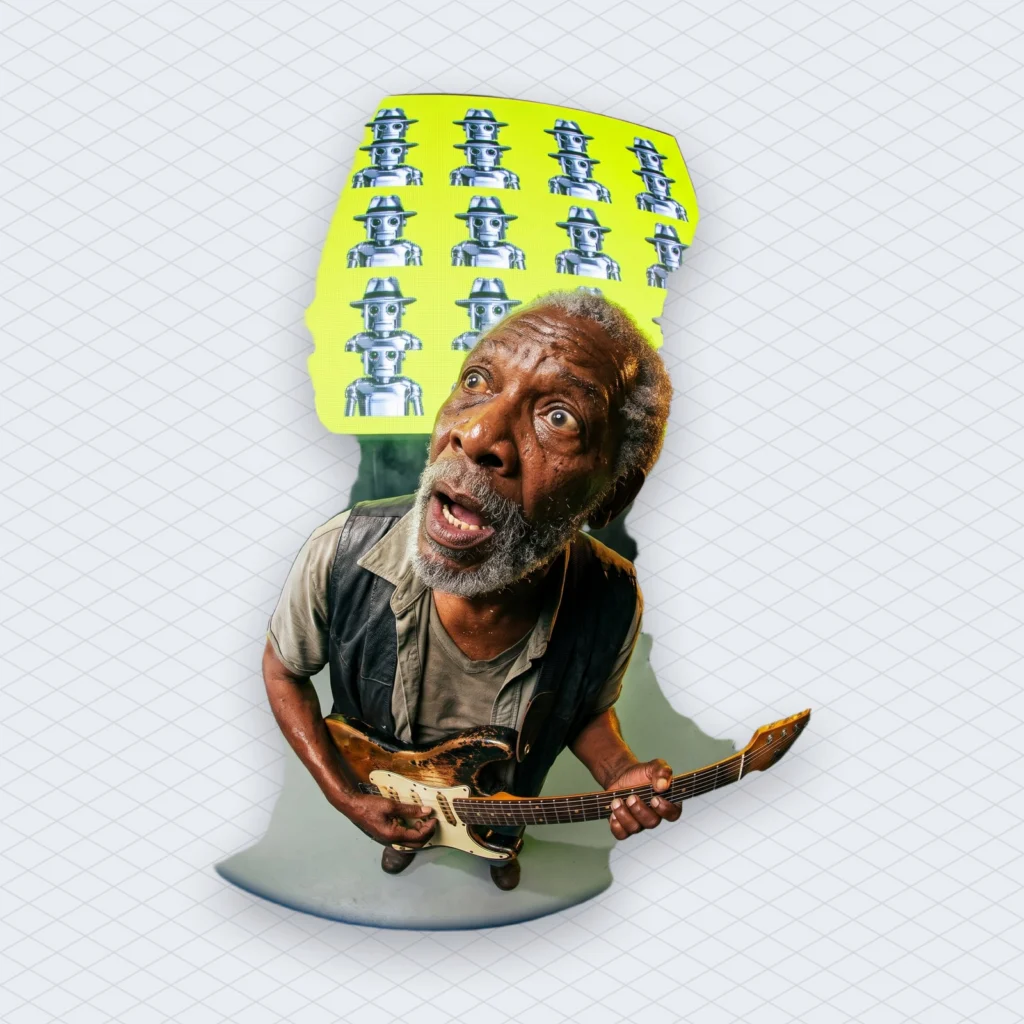
His example was blues charts “being polluted with AI content that synthetically imitates that emotional impact.” It’s an oddly specific place to be invaded. The blues has spent a century being about specific people having specific bad days, and now some of those bad days are made in batches at night. Anyway.
The demand that matters came next. Digital Music News quotes Grainge saying that “the uniform application of pro-rata payments makes the problem worse.” Pro-rata is how most streaming services pay today. All the subscription and ad money goes into one pool and gets split by each track’s share of total streams, so a stream of a 40-second AI loop earns from the same pot as a stream of a Beatles song.
Grainge wants that to change. Treating slop the same as “the greatest songs in the world” incentivises “industrial-scale content production,” he said. He also said “the structure of our DSP agreements has to change” (DSPs are digital service providers such as Spotify or Apple Music) “so the compensation better reflects the value different content creates.” And one line deserves to be read twice: “unethically generated AI tracks should never be compensated on the same basis.”
What happened so far, from the January memo to the UMG Q3 earnings call
- January 2026: Grainge’s annual staff memo warns about the “exponential growth of AI slop” on streaming services, Music Ally reports.
- February 20, 2026: UMG completes the Downtown Music Holdings acquisition, which accounts for most of this year’s growth.
- Mid-October 2026: layoffs and executive exits at UMG labels, including Def Jam and Republic.
- October 29, 2026: UMG publishes its Q3 earnings. On the call, Grainge asks for lower payouts for AI slop and says AI partnerships with companies such as Udio and Klay Vision should bring in incremental revenue in fiscal 2027.
That makes two lists of numbers in one post, so we’ll stop there.
What the UMG Q3 earnings mean for AI music creators
The difficulty is the definition. Grainge did not say “AI music should be paid less.” He said “AI slop” and “unethically generated AI tracks.” In the same breath, the UMG Q3 earnings call talked up the company’s licensed AI deals. “We are moving from principles to products, and from products to revenue,” Grainge said, as DMN reports.
Put those together and the shape is fairly clear. The biggest label wants AI music priced by where it came from. Licensed AI, trained on catalogue the label has been paid for, is a product it plans to sell. Unlicensed, mass-uploaded AI is a cost it wants discounted. The rate a track earns would then depend on its paper trail, and the sound would barely matter.
This is the third step in a direction platforms are already moving. Spotify’s recommendation filter hides tens of millions of tracks it treats as slop, and Deezer is building a toggle to hide fully AI-made music from search. The first step reduces your reach and the second reduces your discovery. A lower per-stream rate would reduce the money from every stream you still get.
Nobody has agreed to this yet. DSP contracts are negotiated privately, Grainge named no rate during the UMG Q3 earnings call, and no platform has publicly signed up for a two-tier payout. Still, when the company collecting the largest share of the pool says the pool’s rules “have to change”, the change usually arrives as a contract clause. Nobody holds a press conference for it.


What we think
Grainge is right that volume uploading is a real problem. Uploading ten thousand near-identical tracks to collect fractions of a cent from playlists isn’t a creative practice. It’s a vending machine pointed at the royalty pool, and it takes money from people who make records.
What concerns us is who gets to decide which tracks count as “slop”. If the label with the most to gain from the pool writes that definition, then “unethical” will probably end up meaning “not licensed from us”. A small creator who makes three careful tracks with a properly licensed tool could end up in the same discount bin as a farm uploading three thousand.
For what it’s worth, most people making AI music don’t behave like a farm. Mubert’s own data, last 28 days: creators who generate music make about 3.4 tracks each. That’s someone scoring a video, not someone flooding a chart.
What to do if you release AI-assisted music
Nothing in the UMG Q3 earnings changes a payout today, but now is the time to prepare. Keep records of how each track was made: which tool you used, its licence terms, and what you changed yourself. If payouts start depending on provenance, that paper trail is your evidence. Read your distributor’s AI policy now, before it gets rewritten. The DistroKid takedowns tied to UMG’s lawsuit showed how fast a distributor can act when a major leans on it. And if you mainly use music in your own videos and don’t release it on streaming services, none of this touches your income. Pro-rata only matters if you’re in the pool.
So that’s the UMG Q3 earnings report. The biggest label in the world made €3.394 billion and spent the call on the cheapest songs. Next time it may be negotiating what those songs earn.
Cover: illustration based on a photo of Lucian Grainge by Luke Harold, CC0.




 Who we are


