




Mozart AI is a music-making app from London startup Arthos. It puts AI generation inside a digital audio workstation, or DAW: the kind of software where you lay out tracks, edit notes and mix. Maybe the name showed up in your feed and you couldn’t tell if it was a song generator, a plugin or a chatbot doing an Austrian accent. This post covers what it actually does, how its pitch changed in eight months, who it suits and what to check before you release anything made in it.
The name Mozart AI promises a powdered wig. What you get is a mixer window and a credit balance.
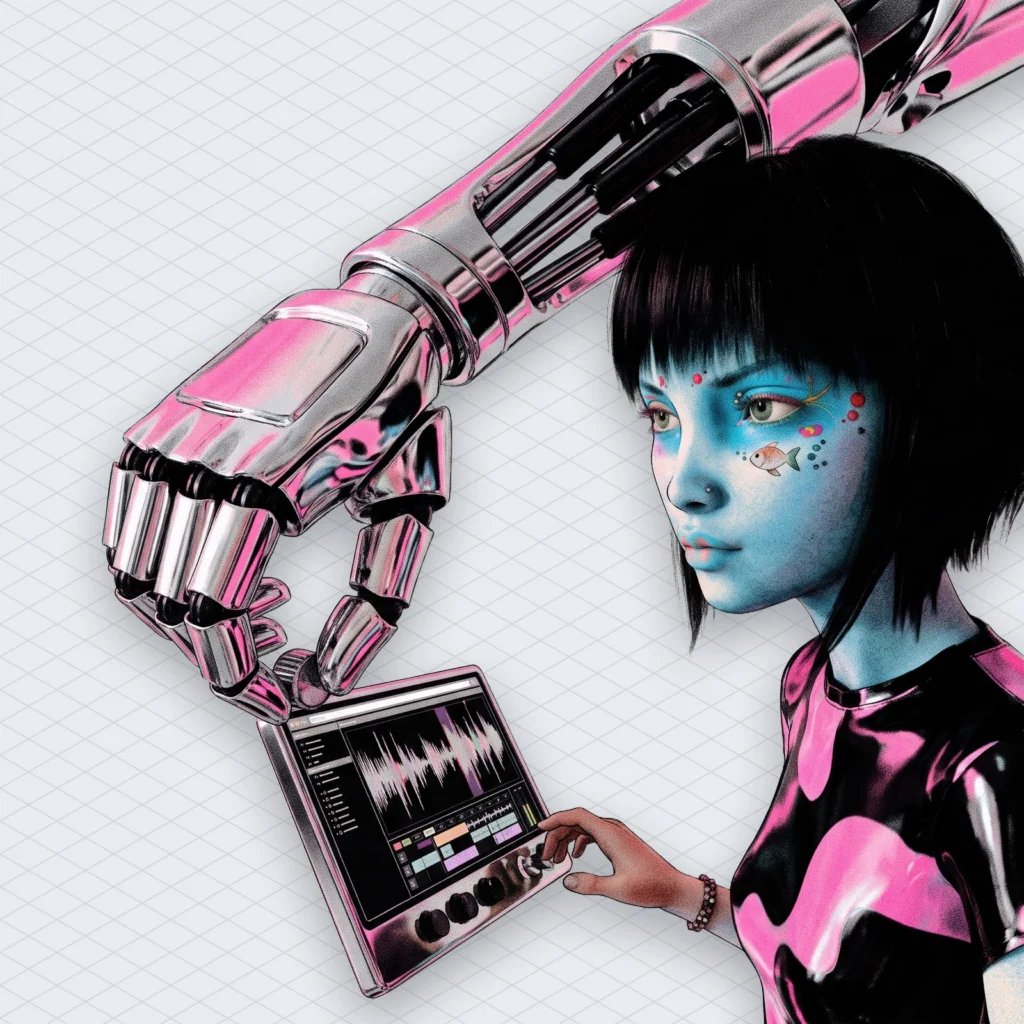
Mozart AI is a music workstation with generators built in
The company calls its product a Generative Audio Workstation, or GAW. That’s a DAW where some of the buttons write music for you. It runs in the browser, as described in a NeurIPS 2025 demo listing, and in February it got a mobile app, Music Business Worldwide reported. You type or speak an instruction, according to Tech.eu’s launch report, and the app comes back with melodies, chords, drums, vocals or changes to the mix.
The team behind Mozart AI is small. In February, Forbes counted ten people, with plans to reach twenty-five this year. Tech.eu says the name Arthos blends “art” and “ethos”, which is the most startup sentence we will type this month. CEO Sundar Arvind was signed to Spinnin’ Records at 14, MBW reports, and he co-founded the company with Arjun Khanna and Pascual Merita Torres.
So here is the honest one-line version of Mozart AI. It’s a beginner-friendly studio where the generator sits next to the piano roll instead of replacing it. (The piano roll is the grid where the notes live. If you’ve never seen one, you’re the audience they built this for.)
The launch pitch said no finished songs
The public launch of Mozart AI was 16 July 2025, and the pitch was careful. Tech.eu passed on two promises from the company: it would never train on artist data, and it would never generate complete songs. The idea was co-creation, with the musician keeping control down to the note.
An EWOR-led pre-seed round paid for the launch. How big it was depends on who you read and in which currency. Tech.eu said €625,000 at the time, and by February MBW was describing the pre-seed as $1.1 million. (Rounds get extended. Currencies wobble. Nobody sends us the spreadsheet.)
That positioning made sense in mid-2025, because “AI music” mostly meant text-to-song tools and the lawsuits that came with them. You can follow that thread in our coverage of the Reservoir complaint against Suno. “We never make the whole song” was a way to say: we’re the other kind. CEO Arvind also gave Music Ally a line that went around a lot, about eliminating friction rather than creativity.
It was a good line. Then the friction turned out to be most of the song.
Eight months later, the songs come finished, with a video
On 11 February 2026 Mozart AI announced a $6 million seed round led by Balderton Capital, with total funding now past $7 million, MBW reported. The stated goal had changed as well. MBW described it as turning ideas into finished songs, with a professional video, without needing technical knowledge.
SiliconANGLE filled in the rest. Mozart AI now supports “agentic” creation driven by prompts, meaning you describe the goal and the software works through the steps. It also generates artwork and can make music videos up to a minute long. The company says it passed 100,000 users within two months of its September beta and that those users have made more than a million songs. Forbes added that the free beta has become a credit system.
Arvind told Forbes that the old process “was just too complex”. Four words, and that’s the whole pivot.
Every generator drifts towards the finish button
We don’t see this as a betrayal. It’s gravity. Any music tool that adds a generator drifts towards the button that says “finish it for me”, because that’s the button beginners press, and beginners are most of the people who sign up. The useful lesson for you is smaller: judge a tool by what it does on the day you use it, not by what the launch post promised.
It also changes what kind of Mozart AI user you are. If you only press the big button, you’re using a song generator with a nicer mixer. If you open the stems and rewrite them, you’re using a workstation. Same app, two very different relationships with the result, and later, with the paperwork.
A confession, since we’re here. We’ve typed “the AI doesn’t replace anyone” in so many drafts that our editor now flags it like a typo. Writing a positioning sentence is easy. Keeping to it once the users arrive is harder.
What you actually do in a Mozart AI session
Forbes describes two modes in Mozart AI. Vibe Sessions are for fast, loose sketching. Studio Sessions give you detailed control, and many users start in Vibe and move to Studio as they get more fluent. Either way, you can start from a hummed vocal idea, a guitar riff or one MIDI progression (MIDI is note data, not audio, so it can be edited after the fact).
From there you work with stems, instruments or single notes. A stem is one layer of the track, like drums on their own or the bass on its own. The app handles the chores in the background, Forbes says. That includes quantisation (snapping sloppy notes to the grid), time-stretching (changing tempo without changing pitch) and sound design. MBW’s list of features is a real list, so here it is:
- stem generation that takes into account what’s already in your session
- real-time suggestions for MIDI progressions, drums, synths and effects
- riffing on any sound and remixing it into a new style
- short music videos for social uploads
“Context-aware” is the part to understand. A standalone generator writes a whole track from a sentence. Mozart AI, in its workstation mode, writes the missing bassline for the eight bars you already have, which is a smaller and more useful thing to ask for. It’s like a session player who has heard the demo, as opposed to a jukebox that hasn’t.
You will still throw a lot away. Generating is mostly drafting. In Mubert Render, our own generator, just under half of generated tracks end up downloaded (Mubert’s own data, last 28 days). The rest get listened to and left. That’s normal for any generator, so when you see a credit system, plan some of those credits for drafts.
The models underneath belong to someone else
This is the part most explainers leave out. According to Forbes, Mozart AI runs third-party models alongside its own systems, and ElevenLabs is one of its main providers. The company also says it doesn’t train its models on copyrighted music and that it licenses commercially cleared datasets.
Think of a sandwich shop that bakes some of its bread and buys the rest from the bakery down the street. Saying so is honest, and it’s more than many shops say. Still, the label on your sandwich is only as good as the bakery’s paperwork. With music, your rights chain runs through two sets of terms: the app’s and its model provider’s.
Licensed training data is a much better claim than silence, especially now that labels and publishers are suing AI companies over what went into their models. Our post on the Anthropic lyrics case reaching its fair use hearing shows where that argument is headed. But a claim isn’t a document. If you plan to put a track on a streaming service or under a client’s ad, the document is what you want.
“Commercial rights” is a sentence, not a licence
In the MBW piece, Arvind says users can turn ideas into songs “with commercial rights”. SiliconANGLE noted that the announcement gave no further detail on licensing terms. Neither of those is a problem in itself. Press releases aren’t contracts, and nobody expects them to be.
So read the Mozart AI terms for the plan you’re actually on, and look for a few specific things. Who owns the output? Does a free tier come with different rights than a paid one? Can you register the track with a distributor and collect royalties, and can you enrol it in a content-ID system that claims other people’s uploads? (That last one surprises people, and it’s where the angry emails come from.)
Then save a dated copy of those terms next to your project. This app has already changed its pitch once in eight months, and terms move with pitches. If a question ever comes up about a track you released in spring, you want the rules from spring, not the version that went live last Tuesday.
Copyright covers the parts a human made
Ownership in the copyright sense is a separate question from the app’s terms. The US Copyright Office’s AI guidance says copyright protects human authorship. Material generated purely by a machine isn’t protected, but what a person selects, arranges or changes can be. A workstation helps here, because it records your decisions. The riff you played and the bars you rewrote are yours. The bassline you accepted without touching probably isn’t, at least not in the same way.
Platforms are starting to sort this out for you as well. YouTube Music now puts a badge on songs made mostly by AI, and Deezer is building a toggle that hides fully AI-made tracks from search. A track you mostly played yourself is a different case from a track you prompted. Keep the files that show which one yours is.
How to test Mozart AI in one evening
Don’t judge the app by its first output. We did that once with a different generator, loved the first track, then spent a week learning it had one trick. It went badly. Instead, give Mozart AI a job you already know the answer to.
Pick an idea you already have: a riff, a hummed hook, a chord loop from an old project. Start it in a Vibe Session and let the app run. Then open the same idea in a Studio Session and try to change one thing by hand, like a single bass note or the drum fill before the chorus. If that edit is quick, the workstation part is real for you. If it’s a fight, you’re mostly using the generator, and you should price it like one.
Next, ask for one missing part, not a whole song. A good result stays in your key and your tempo and leaves space for what you already played. A weak one ignores the session and brings its own ideas, like a guest who rearranges your kitchen.
Then count the credits. Note how many generations it took to get one part you’d actually keep, because that number is the real price of a usable draft. Check the export too. Find out if the stems can leave the app for another editor, or if the work lives only in the browser.
Last, write down what you did. Which bars came from you, which came from the generator and which you changed afterwards. It takes two minutes, and it’s the same note the copyright section above asks you to keep. Doing it on the first evening makes it a habit instead of a chore.
Who Mozart AI suits, and who should skip it
Mozart AI makes the most sense for people who want to learn production while they produce. Brazilian producer Arthur Penna told Forbes that “someone who is just learning to use a DAW is going to benefit a lot”, which sounds right to us. You get to see the stems and the notes, so you pick up how a track is built instead of just receiving one.
It also fits songwriters who have a riff and no band, and producers who want a sketch partner at midnight. The company says people who have produced for A$AP Rocky, Avicii, Kodak Black and Lil Baby use it. That tells you about the ceiling, not about your floor.
Skip it if what you need is music under a video, not a song. A YouTube edit or a product demo needs a bed that fits the cut to the second and stays out of the way of the voiceover, and that’s a different job (we covered it in how to make music fit your video length). Skip it, or at least read the fine print twice, if you plan to sell tracks somewhere that restricts AI-assisted work. And if you’ve spent ten years building muscle memory in a desktop DAW, treat the browser version as a sketchpad and see if it earns more than that.
The composer is not involved
Wolfgang Amadeus Mozart died in 1791, and Mozart AI only borrows his name. His compositions have been in the public domain for a long time, so you could arrange any of them today without asking anyone. Recordings of them are a different story, which we explained with a less powdered example in our post on Christmas music for videos.
The tangent we can’t resist: a dice game for composing minuets came out under his name in 1792, a year after his death. You rolled dice to pick prewritten bars and assemble a piece. Nobody is entirely sure he wrote it, which makes it the first generative music product with a disputed attribution. Some traditions are older than the lawsuits.
Anyway.
A checklist for trying Mozart AI this week
- Read the Mozart AI terms for your plan, especially output ownership and commercial use.
- Save a dated copy of those terms in the project folder.
- Start with your own riff, hum or chord progression instead of a blank prompt.
- Save the project file and the stems for every track you might release.
- Note which parts you played and which ones the generator wrote.
- Check your distributor’s AI disclosure rules before you upload anything.
- Set aside credits for drafts, because most generations won’t be keepers.
- Use a dedicated background-music tool when the job is a video bed, not a song.
If anyone asks whether Mozart wrote your track, the answer is no. The wig stays in Vienna, and the receipts stay in your project folder.




 Who we are


