
Eurovision AI songs have now reached the national selections in Sweden and Norway, and neither broadcaster can prove which entries they are. SVT got a record 4,077 entries for Melodifestivalen 2027. It expects some were made with AI. Still, it has no rule against them and no tool to find them. Norway’s NRK bans fully AI songs and thinks 30 to 50 came in anyway. This post gives you the timeline, explains how each broadcaster spots these songs, and covers what it means if you release music made partly with AI.
Somewhere in Sweden, a jury member is on song 2,912 of 4,077, and a few of the songs still waiting, SVT believes, were written by something that has never once needed a coffee to get through the afternoon. The jury member has had four.
Eurovision AI songs hit Sweden and Norway on the same day
The Swedish side of the story came out through Aftonbladet on 12 October. Melodifestivalen project manager Anders Wistbacka said his team is “convinced that we will receive quite a few AI songs” (Eurovoix). He can’t say how many, though. SVT uses no specialised detection tool, so any count of Eurovision AI songs in the pile is a guess (Eurovisionfun).
Norway responded the same day, with a rule on Eurovision AI songs already in place. NRK bans pure AI compositions from Melodi Grand Prix (NRK). Even so, Head of Delegation Mads Tørklep thinks 30 to 50 of the roughly 1,500 entries for 2027 are pure AI (Blikk). That works out to somewhere between one entry in 30 and one in 50, and nobody in Sweden knows their own ratio, because nobody there is counting and nobody there has anything to count with.
What happened so far
- 2024: Una Voce per San Marino became the only selection so far to welcome AI. Four songs written with its help were in the running (Eurovoix).
- January 2026: Jacub’s “Jag vet, du är inte min” hit No. 1 on Spotify’s Swedish Top 50. Then IFPI Sweden blocked it from Sverigetopplistan, the official chart (Music Business Worldwide, Sveriges Radio).
- 21 August to 11 September 2026: the Melodifestivalen window closed with 4,077 songs, beating last year’s 3,888 (ESCToday).
- Early October 2026: SVT confirmed five heats and a final, with six songs per heat (ESCXTRA).
- 12 October 2026: SVT said it expects AI songs among its entries and won’t ban them. NRK confirmed its ban and its estimate.
- Next: an industry jury cuts the 4,077 entries down to about 30 competing songs.
Sweden spots Eurovision AI songs by the sender, not the sound
Sweden has no detector, so it watches how people behave. Wistbacka’s example is an unknown songwriter sending lots of songs across lots of genres. That alone, he said, suggests AI may be involved.
Read that twice.
The flag goes up on the person rather than the audio: an unknown name, a large number of entries and a dozen genres arriving from the same inbox in the same three weeks. But a prolific human who can’t settle on a genre fits that profile too. (We know a few. They are tired.)
SVT won’t write the rule itself, either. According to Eurovoix, Wistbacka says the music industry has to settle the question, and SVT will then follow whatever it decides. His safety net is the stage. Every song still needs a performer, entries go through several rounds of judging, and the shows are live. “It will not be a computer going up on stage and singing on Saturdays,” he said (Eurovisionfun). So he thinks a fully AI song is unlikely to make the 30. Unlikely is not impossible.
There’s a cost angle too. SVT listens to every entry, and Wistbacka warned that 10,000 submissions would mean a bigger judging budget. When making a song costs one prompt and listening to it costs a trained human with a scoring sheet and a fixed budget, the expensive part of a song contest quietly moves from the studio to the jury room.
Norway bans fully AI Eurovision songs and still got 30 to 50
NRK’s reasoning fits in one line. Tørklep told NRK there is “no point having a music contest where a computer has done the whole job”. Enforcement is done by people listening. An editorial team led by music chief Tarjei Strøm goes through every entry (Blikk).
The ban is narrower than it sounds. Only fully generated Eurovision AI songs are out. A human writer who used a tool somewhere along the way, for a chord idea, a rough demo vocal or a lyric that refused to rhyme, is still in.
The people sending pure AI songs aren’t scheming. According to Tørklep, most are open about it: they prompted something they liked and sent it in. “They’re not musicians,” he added. Ordinary people, then. A button and a dream.
A short tangent. Norway has already had a Melodi Grand Prix song called “My AI”, the 2024 entry by Erika Norwich and Super Rob, a nearly three-metre robot. Despite the title and the robot, four human songwriters are credited on it (Eurovisionworld). Anyway.
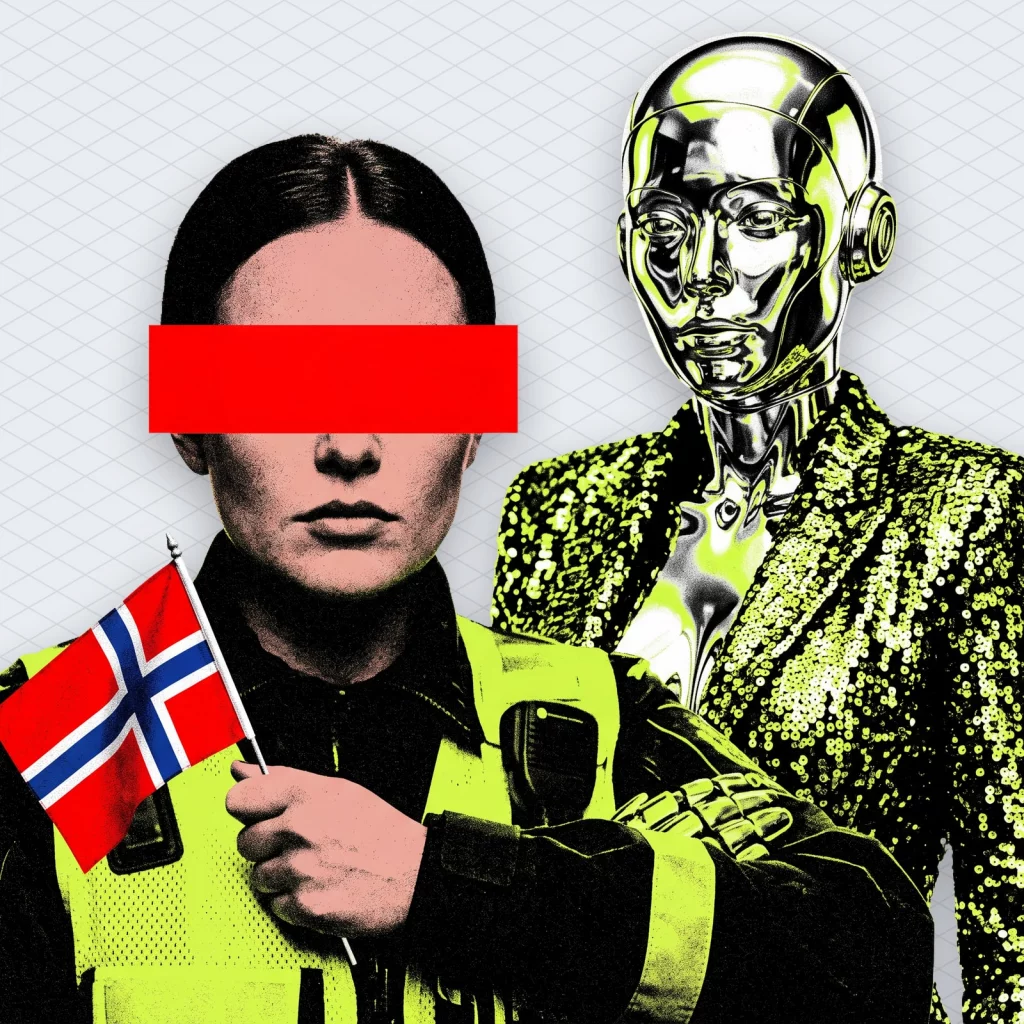
Eurovision has no rule for AI songs, so every gate writes its own
The contest itself hasn’t decided anything. Eurovision has no set rule on AI in competing songs (Eurovoix). So each national selection decides what to do with Eurovision AI songs on its own. Sweden allows AI. Norway bans fully AI songs. Meanwhile, Greece’s ERT has banned AI outright in Sing for Greece 2027.
Then there’s the chart. IFPI Sweden’s CEO Ludvig Werner says songs that are “mainly AI-generated” don’t have the right to be on the official list (Music Business Worldwide). That makes four standards in one corner of Europe. Nobody has published the percentage at which “assisted” becomes “mainly”.
One track. Three verdicts. It could pass in Stockholm, fail in Oslo and fail in Athens, and it takes a remarkable amount of paperwork to be that confusing.
What this means for your own AI-assisted releases
You may never enter Melodifestivalen. The pattern still applies to you. Contests, charts and distributors are writing AI rules on their own schedules. Every gatekeeper here separates “fully AI” from “AI as a tool”. The Eurovision AI songs story just makes that split easy to see.
They enforce it in similar ways, too. Behaviour gets checked before the audio does: how many songs you send, how many genres, whether anyone knows your name. We saw the same thing in the Michael Smith streaming fraud case, where the sheer volume gave him away.
A confession, since we have a stake in this. We make a generative music tool, built on samples that musicians upload and get paid for. That doesn’t settle any contest rule for you. But it does mean we spend a lot of time asking where a sound came from, and gatekeepers have started asking exactly the same question.
What to do before you submit AI-assisted music anywhere
Read the rules of every place you submit to, every time. “AI allowed” in Sweden and “fully AI banned” in Norway are different rules that happen to share a border.
Keep your drafts, stems, lyric notes and session files, because if anyone ever asks whether a person wrote this, a project folder with timestamps is a much better answer than a promise delivered in a confident tone. If you write in many genres, send fewer, better entries under your own name. That’s exactly the profile SVT watches for. Also, say which tools you used. Tørklep’s open senders were easy to set aside, so nobody had to play detective.
Our guide to writing a song with AI shows where the human part ends and the tool begins.
Meanwhile, Sweden’s Eurovision jury is still listening for AI songs. Song 4,077 is in the queue. Song 4,078 is presumably being prompted for next year, by someone who has never needed a coffee either.
 Who we are