

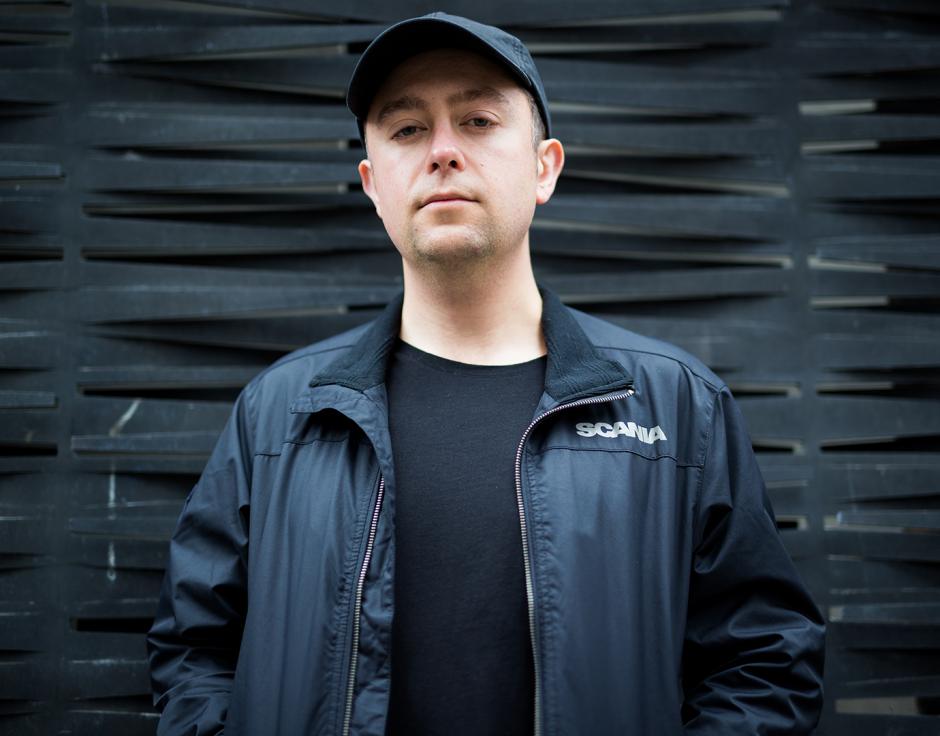
Essex-based audiovisual maverick Sim Hutchins is often working on collisions of lowbrow cultural touchstones of the social media age and high-concept experimentalism. With his teenage obsession with metal and drum’n’bass, he was involved in the local ‘Ardkore community very early on, working with grime MCs, playing on pirate radio and at East Anglian free parties. His debut album “I Enjoyed To Sweep A Room” was released by the label “No Pain In Pop” after some friendly trolling of their Twitter account with mysterious messages encouraging them to listen to his demos.
Slo-mo techno, woozy lo-fi beats and broken drone, recorded on his collection of bad gear and outdated equipment turned the rising producer into a prominent voice in the British electronic underground. Multimedia work “Vantablank Stare” for Lee Gamble’s UIQ label was born from a personal discontent with vacuous repetition of 24 hour rolling news.
A web installation of eerily empty TV screens with a running fake news feed in English, Arabic and Russian perfectly mirrored the concept of record: ghosts of hardcore continuum, dub techno miasma and jungle euphoria of the post-truth era. His next audiovisual work “Club Love” supported his release on London label “Local Action”, an interactive web project exploring people’s personal stories, memories and interpretations of love in the club. For his latest releases and videos Sim Hutchins mines the collective consciousness of club nostalgia, where EDM links arms with IDM in a moshpit of playful audiovisual works (all washed down with a hint of aural agitation).
Would you consider AI as a competitor or as an extension of your talent and skill?
It’s a tool. Let AI generate things and sort through those things, as a human.
Suggest your idea of a fair royalty distribution system. What is it and how does it work?
If you can agree the terms before, then letting systems akin to ContentID sort though to claim royalties on your behalf is instantly saving you time, hassle and Excel spreadsheets.
Based on your experience with Mubert how would you rate AI working with your samples?
I’ve been using the clip randomisation feature in Ableton for years, so Mubert’s style of combining loops sounded not unfamiliar to me. What I found cool though was hearing things in the system evolve as I was putting the project together – there were some upgrades going on at the time – and going back a week later I heard new arrangement combinations I’d not experienced before.
What is the difference between creating your regular work in the form of a finished track and working with AI for a project with an unknown result?
I’m currently working on very rigid verse/chorus “songs” for artists and have been for a while. So collaborating with Mubert brought me back to the experimental side I’ve been neglecting to tend to – and it feels good, man.
What do you think about services like Mubert as an alternative format for dominant forms of music like singles or albums?
I think it’ll come down to either what the average music listener seeks out or what’s pushed onto them. Personally I’m an avid fan of guys like Lorem and Renick Bell who use a combination of AI algorithmic composition and exquisite human taste.

 Who we are