Smart Home Apps
The future of content sound: Instantly access generative, copyright-safe Smart Home Apps for all your broadcast needs, powered by Mubert.
The problem
Smart Home Apps
Problem
Loops that wear out in a home
A speaker in a kitchen or living room plays the same few ambient tracks for hours, every day. Residents notice the repeat within a week, mute the scene, and the feature stops being used.
With Mubert
Mubert streams generative music that does not loop, with 150+ moods and themes. Intensity can shift while the stream plays, so a morning routine and a late evening wind-down never sound like the same recording.
Problem
Scenes that change faster than tracks
Smart home scenes switch on triggers like a door opening, lights dimming, or a timer ending. A fixed track either cuts off hard or keeps playing the wrong mood after the room has changed.
With Mubert
The WebRTC stream has sub-second latency, and intensity can change mid-stream. Your backend can move the music with the scene. For fixed-length needs, tracks can be generated from 15 seconds up to 25 minutes.
Problem
One account, many households
A smart home app has thousands of households, each with its own rooms and tastes. Sharing one login for all of them makes usage hard to trace, and personalizing music per home is painful to build.
With Mubert
Your backend creates a customer for each user, with its own customer-id and access-token, and their usage counts against your license. Like and dislike feedback can then personalize the music for each household.
Apps
By the numbers
Paid in 2024 for music at live events and in hotels, restaurants and shops
Damages publishers sought from Peloton over songs used without licenses in its classes
Damages publishers sought from Roblox over unlicensed music in user-made games
Smart Home Apps
How it fits your product
Smart home music plays for hours in rooms where people talk, cook and sleep, so it should stay low in energy and out of the way. Aim for slow tempos, soft pads, felt piano and gentle plucks, with no sharp transients that compete with voice assistants or door chimes. Avoid vocals. Use endless streams rather than loops, because a repeating four-minute clip becomes noticeable by the second hour.
For a smart speaker or home hub app, use the realtime stream mode: your backend creates a customer for each household, hands the app its customer-id and access-token, and the app plays a WebRTC stream by mood. Map scenes such as Morning, Dinner or Sleep to different moods, and change intensity while playing when a scene switches. Add like and dislike buttons so each home's music adapts.
With the Mubert API
Mode
Stream
Length
Endless
Tempo
60-80 BPM
Mood
Calm, warm, unobtrusive
Example prompt
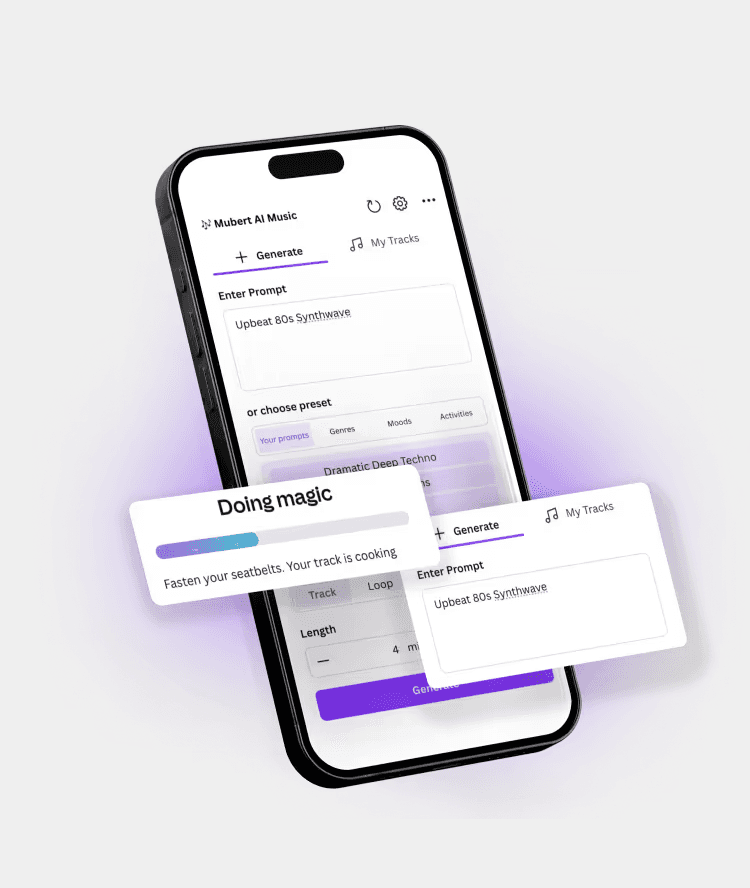
Warm ambient pads, soft piano, slow tempo, calm evening mood for a living room smart speaker
More prompts to try
Soft acoustic guitar and light percussion, upbeat morning mood for a kitchen routine
Minimal lo-fi beats, mellow Rhodes chords, relaxed tempo for evening focus in a home office
Slow drifting synths and distant chimes, very quiet sleep mood for a bedroom scene
Features
What you get
Personalization
Create personalized music UX with like/dislike music training
Neverending Streaming
Stream non stop realtime generated roaylty-free music channels
15-Second+ Generation
Create short-form music starting from 15 seconds
FAQ
Smart Home Apps
What kind of music works as background audio in a smart home app?
Low-energy, instrumental music with slow to moderate tempos works best, since it plays for long stretches and sits under voice assistant responses and notifications. With the Mubert API you can pick from 150+ moods and themes in a realtime stream, and change the intensity while the stream plays.
How do I give each household in my smart home app its own music?
Your backend creates a customer in the Mubert API for each user, which returns a customer-id and an access-token. The app uses those credentials to request music, and that user's usage counts against your license. Like and dislike feedback can then personalize what each household hears.
More use cases
Pricing
Transparent & Flexible
Blog