 is live now • Soundtrack your videos

 Home
Home

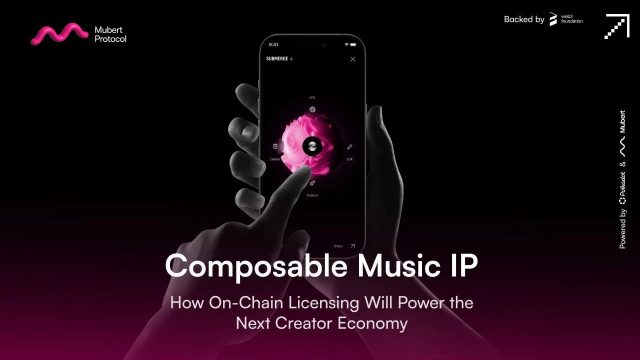
Generative AI has made creating music easier than ever. Millions of new tracks can be generated with a prompt, sound libraries can be remixed infinitely, and creative boundaries are constantly being stretched. But the systems that govern music ownership and compensation haven’t evolved at the same pace.
Artists still wait months for royalty checks. Dataset contributors rarely see revenue from the AI models trained on their work. Licensing across platforms remains messy, inconsistent, and often stacked against smaller creators. The result is a widening gap: while creativity scales infinitely, compensation remains locked in outdated structures.
Mubert is working to close that gap. By combining generative AI with blockchain infrastructure, it introduces a model where music and other creative IP are broken into modular, traceable units that can be licensed, recombined, and monetized transparently. This idea, Composable Music IP has the potential to redefine how the creator economy works.
What Is Composable Music IP?
For most of the music industry, intellectual property (IP) has been treated as a finished product, a track released on Spotify, a beat licensed to a label, or a catalog sold to publishers. Rights and royalties are managed at this macro level, which makes the system rigid, slow, and prone to disputes.
Composable Music IP flips this model on its head. Instead of viewing music as one indivisible asset, it breaks it down into its core components, samples, stems, MIDI files, loops, and even stylistic tags. Each component can be individually tokenised, registered on-chain, and linked back to its creator with cryptographic proofs.
Why does this matter? Because when music is made from smaller, traceable pieces, it becomes possible to:
- Remix and reuse freely: A drum loop from one producer, a bassline from another, and an AI-generated vocal can all be combined into a new track.
- Preserve attribution: Blockchain records and zero-knowledge proofs guarantee that every contributor is recognised.
- Automate payouts: Smart contracts distribute revenue instantly and proportionally, whether the track is streamed, used in a game, or embedded in a video.
The result is music that is not only modular in its creative form but also modular in its economic structure. Every fragment of contribution, no matter how small, can carry value and generate ongoing income.
This is why the idea of “composability” is so powerful: it transforms music from a static asset into a living, reconfigurable resource. For creators, it means new ways to collaborate and monetize. For platforms, it means legally sound access to AI-driven and user-generated content. And for the broader ecosystem, it lays the groundwork for a more open and equitable creator economy.
Why On-Chain Licensing Changes Everything
Music licensing has always been a slow and opaque process. Whether it’s collecting royalties from streaming services or negotiating sync deals for film and advertising, creators are at the mercy of intermediaries. AI-generated music only complicates things further, raising new questions around authorship, ownership, and legality.
On-chain licensing introduces three critical shifts:
- Automated attribution: Fingerprinting systems and zero-knowledge proofs tie every asset back to its original creator, no matter how many times it is remixed.
- Instant revenue distribution: Smart contracts split and deliver payments the moment content is used, removing delays and middlemen.
- Cross-platform enforceability: Tokenized assets can be licensed seamlessly across platforms like Spotify, TikTok, Unreal Engine, or metaverse worlds, ensuring rights follow content everywhere.
Instead of royalties trickling through months of paperwork, licensing becomes a real-time, programmable event.
Inside the Mubert Protocol
Mubert is not just an AI music generator. It is an end-to-end infrastructure for creative IP. Key components include:
- Decentralized Datasets: Mubert tokenizes its 3M+ sound library and enables creators to tokenize their own samples or tracks, ensuring every contribution is traceable.
- Tokenised Taxonomies: Genres, moods, and stylistic tags are stakable tokens. Supporting a tag (e.g., “ambient”) means you share in its monetisation whenever it’s used.
- Artist Vaults: Every creator has a Web3-native vault storing their works, NFTs, staking positions, and real-time revenue.
- Dynamic Content NFTs: Beyond static tracks, Mubert supports adaptive formats like real-time generative loops, interactive soundscapes, and dynamic NFTs.
- SampleID for Catalogs: Large libraries can tokenize entire archives, with automated licensing and royalties that extend across chains.
Together, these features create a granular rights framework where every asset, no matter how small can be owned, licensed, and monetized with precision.
Who Benefits From Composable Music IP?
Artists
Independent musicians gain a transparent system for licensing and revenue. Even atom-sized contributions, like a single snare sample can generate income whenever they’re used downstream.
Dataset Suppliers
The individuals and libraries whose recordings train AI models finally receive fair compensation. Their data is no longer a sunk cost but an ongoing revenue stream.
Developers & Platforms
With APIs, SDKs, and plugins, developers can integrate licensed music directly into apps, games, or content platforms. This reduces legal risk while unlocking richer creative possibilities.
Legacy Catalog Holders
Stock music libraries, labels, and agencies can onboard catalogs on-chain, tapping into new revenue channels like fractional licensing, DAO collaborations, or cross-chain DeFi integrations.
Communities
By staking on genres, styles, or taxonomies, fans and curators can influence the growth of cultural niches, while earning rewards for their role in shaping creative ecosystems.
The system realigns incentives: instead of value concentrating in a few hands, it flows transparently across the entire creative chain.
Roadmap: From Music to a Universal Creative Economy
Mubert’s roadmap is ambitious but logical, building layer by layer:
Phase 1: Music Ownership & Monetisation
On-chain attribution and licensing for tracks, samples, and voices, with automated revenue splits.
Phase 2: Expansion Across Media
Extending the same tokenization and licensing framework to AI-generated video, text, and images, with cross-chain interoperability.
Phase 3: Universal Content Infrastructure
Any creative work, from a Canva design to a YouTube video can be tokenized, licensed, and monetized across Web2 and Web3 ecosystems, with real-time attribution and revenue flows.
If successful, this trajectory positions Mubert as a foundational layer for the next generation of the creator economy, not just for music but for all media.
Why Mubert Stands Apart
While many projects experiment with AI music, few address the structural failures of ownership and licensing. Mubert’s edge lies in three areas:
- Scale of adoption – With 100M+ AI-generated tracks and 28M+ API users, Mubert already operates at global scale.
- Granular attribution – Features like SampleID and ZKML bring rights management to an atomic level.
- Composable economics – Every creative fragment becomes a financial primitive, enabling new models of collaboration and revenue.
This is about building the IP infrastructure that AI-generated culture demands.
To sum up, the challenge of the AI era isn’t generating content, it’s ensuring that the humans and communities behind it remain visible and rewarded. Traditional licensing cannot keep up with the scale, speed, and modularity of digital creativity.
Composable Music IP, powered by on-chain licensing, offers a way forward. By making ownership granular, attribution automatic, and payouts real-time, it turns creative work into a transparent and collaborative economy.
For artists, it means new ways to earn. For platforms, it means legally sound innovation. For audiences, it means a cultural landscape where creativity thrives without exploitation.In short, the soundtrack of the future won’t just be AI-generated. It will be composable, on-chain, and owned by the many, not the few.

AI Music Company
Mubert is a platform powered by music producers that helps creators and brands generate unlimited royalty-free music with the help of AI. Our mission is to empower and protect the creators. Our purpose is to democratize the Creator Economy.