
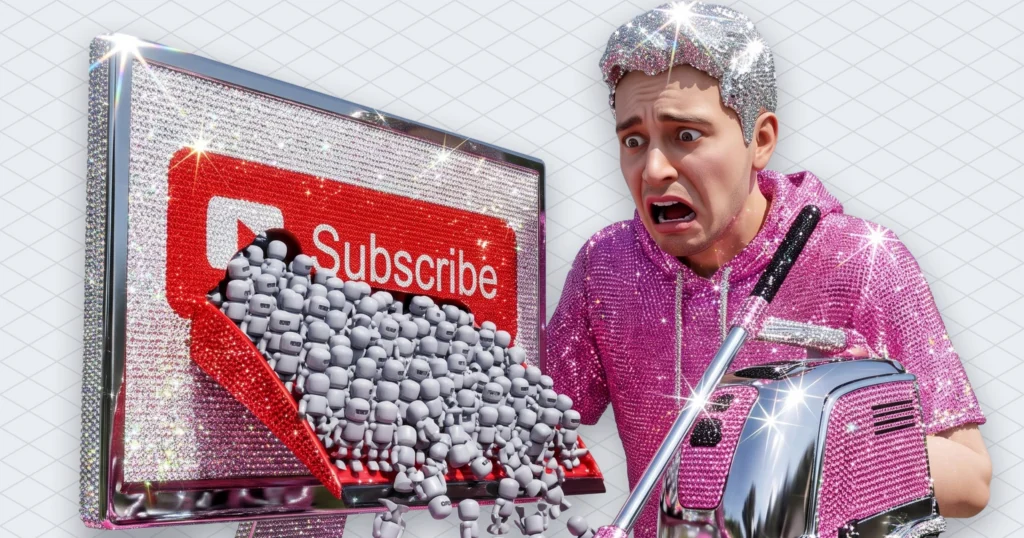
Free YouTube subscribers from sub-for-sub and “free trial” sites do not count. YouTube says it leaves subscribers gained through artificial means out of your total, and its Partner Program wants 1,000 real subscribers before ads pay you anything. This post is for small channels sitting on a three-digit count who wonder whether a free boost is harmless. It covers what those sites send, what YouTube’s policy does about it, and the free settings in YouTube Studio that turn viewers into subscribers who stay.
A bot subscriber is a chair at your gig with a coat thrown over it. The room looks fuller. Nobody claps.
Free YouTube subscribers are left out of the count, by YouTube’s own rules
YouTube’s subscriber count help page calls subscribers “gained through artificial means, such as purchasing subscribers through a third-party service” spam, and says spam “won’t count toward your total number of subscribers.” Getting them as free YouTube subscribers instead of paid ones changes nothing. A subscriber you earned from a coin exchange is just as artificial as one you paid for.
The fake engagement policy goes a step further. It says removing these accounts “shouldn’t impact your views or watch time”, because they “aren’t active viewers.” Read that twice. YouTube is telling you in writing that these accounts never watched anything.
The cleanup is old news. In June 2014 YouTube announced it would strip suspended accounts from every channel’s count starting June 16, and then keep doing it automatically. In December 2018 it warned creators of a “noticeable” drop on December 13-14 while it removed spam subscriptions. Channels with a lot of spam that fell under 1,000 lost Partner Program eligibility and had to reapply.
So the cleanup is not a one-off event. It’s the weather.
What free YouTube subscriber sites actually send you
Most free YouTube subscriber sites run one of two models, and neither one sends viewers. The first is an exchange: you subscribe to other members’ channels, earn points, then spend the points on subscribers for your own channel. A free trial is the second, where a small batch of accounts lands on your channel and a price list follows close behind.
In practice the exchange is sub4sub with a dashboard. Everyone in it subscribed to get something back, not to watch. So your new subscribers care about your videos exactly as much as you care about theirs, which is not at all. You were there for the points.
The trial batch is a different animal, with the same result. YouTube said in 2018 that spam services often subscribe to lots of unrelated channels to disguise what they are doing. It backfires. That pattern is exactly how they get spotted, because an account following a crochet channel, a crypto channel and yours in the same minute does not look like a fan. It looks like a bot.
Free YouTube subscriber sites want your Google login, and that part is real
Some sites ask you to log in with the Google account that owns the channel, so they can “deliver faster”. Think about that. You would be swapping access to your actual channel for a handful of strangers (it is the one part of the deal where the site gets something real).
Then there’s the supply. A site that hands out free YouTube subscribers has to get them from somewhere. Only two places exist. That somewhere is always other members’ accounts or accounts the site runs itself, and neither kind has ever sat through one of your videos.
A confession: we once typed this exact search into a browser too, on an old side channel whose subscribers were mostly relatives. We closed the tab at the sign-in screen. Best decision that channel ever made.
The same model runs on other platforms with different logos. We went through the Instagram follower trial sites and the TikTok follower farms before this, and the ending is always the same: the platform counts again and the number drops.
YouTube monetization needs 1,000 subscribers and a review of the whole channel
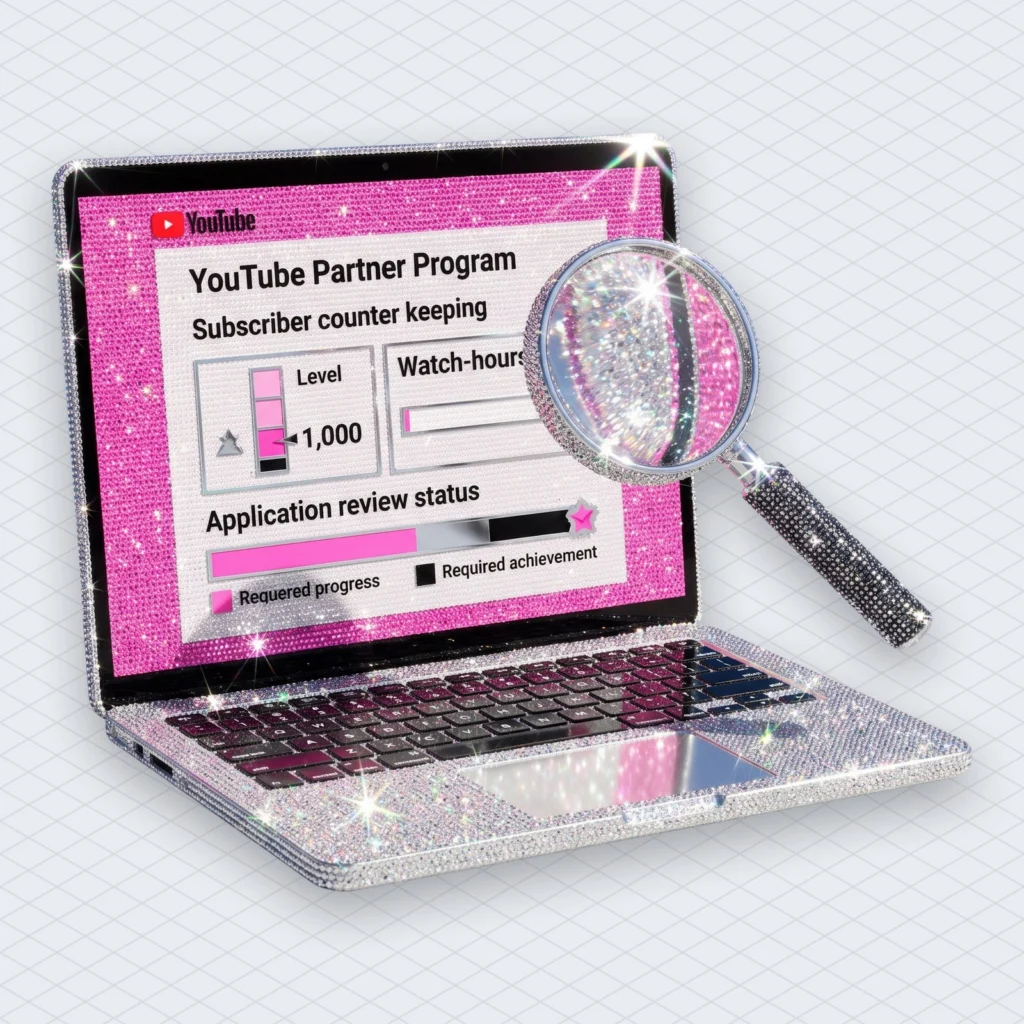
Ad revenue needs 1,000 subscribers plus either 4,000 qualified watch hours in the last 12 months or 10 million qualified Shorts views in the last 90 days, according to the YouTube Partner Program page. In some countries there is also a lower tier at 500 subscribers. It asks for 3 public uploads in 90 days plus 3,000 watch hours or 3 million Shorts views. That tier opens channel memberships, Super Chat, Super Thanks and Shopping, but ads still wait for the 1,000 line.
Look at which half of each rule a bot can fill. Free YouTube subscribers can push the counter toward the line, at least until the cleanup. The watch-hour half, never, because YouTube’s own text says spam accounts add no views or watch time. So a traded count can pass 1,000 while the watch-hour bar stays exactly where it was. Bot views don’t help either. The policy says artificial traffic “will not be counted on YouTube and can lead to strikes.”
Hitting the numbers doesn’t get you in automatically, either. You apply, YouTube reviews the channel “typically in about 1 month”, and it keeps checking channels that are already in. A reviewer looking at a channel whose subscribers never watch anything does not need a forensics lab.
Side note: the public subscriber number is rounded. Under 1,000 it goes up one at a time. Between 1,000 and 9,999 it moves in steps of 10, and at 1,234,567 subscribers the public count reads “1.23M”, per the help page. So subscriber number 1,004 arrives in total public silence, and only your Studio dashboard throws a party. Anyway.
Sub4sub is the free trick YouTube names in its policy
YouTube’s fake engagement policy lists “offering to subscribe to another creator’s channel only if they subscribe to your channel” as banned. It also bans content that “links to or promotes third-party services that artificially inflate metrics like views, likes, and subscribers.” The spam policy counts sub4sub as incentivization spam as well. So the one way to get free YouTube subscribers that costs literally nothing is the very one written into the rulebook.
The penalties come in steps. A first violation usually brings a warning with no penalty to the channel, plus a policy training. The warning expires 90 days after you finish the training, and the clock starts at the training, not at the warning. After that come strikes, and “if you get 3 strikes within 90 days, your channel may be terminated.” YouTube can also remove a channel after “a single case of severe abuse.”
Outsourcing doesn’t protect you. The policy says plainly: “If you hire someone to promote your channel, their decisions may impact your channel.” A free site doing the subscribing on your behalf is still doing it for your channel, and the strike lands on your channel too.
Asking is still allowed. The same policy says encouraging viewers to subscribe, like, share or comment is fine. “Subscribe if this helped” is allowed. “Subscribe to me and I’ll subscribe back” is not. The whole difference is one conditional clause, which is about as lawyerly as YouTube gets.
Fake subscribers wreck the numbers you use to grow
Fake subscribers do nothing while they’re counted, and they leave a mess when they go. The mess is in your Analytics, and Analytics is the only tool a small channel has for working out what works. YouTube says it “regularly checks account legitimacy” and may correct Analytics metrics after the fact. So the chart you are reading may get rewritten under you.
The real cost is what you can no longer learn. A small channel grows by spotting which video made people subscribe and making more videos like it. Free YouTube subscribers that arrive in one batch on a Tuesday make Tuesday’s video look like a hit. If they disappear in a cleanup, the drop looks like your audience left. Neither is true, and you end up planning next month’s videos around noise.
Your subscribers’ feeds have the same problem. A subscriber who never opens your uploads is one more person who got shown your video and ignored it. YouTube doesn’t publish exactly how much that weighs, so we won’t put a number on it. Still, having an audience that doesn’t watch is a strange thing to aim for.
If your count drops one day after a round of free YouTube subscribers, check Studio first. The help page says normal ups and downs are common, and that if YouTube removed spam subscribers from your channel “you’ll get an alert in YouTube Studio.”
Cleaning up after a free subscriber site starts with your password
If you already took free YouTube subscribers from a site, fix your password first and leave the count alone. Change it on the Google account that owns the channel. Then remove the site’s access in your Google Account’s security settings, because “connected apps” is exactly where a sub site likes to live.
After the login, leave the exchange. Unsubscribe from the channels you followed for points. You were their bot, after all, and the policy that bans offering sub4sub doesn’t care which side of the trade you were on.
Then do nothing to the number. Don’t top it back up after a drop, and don’t buy a “refill” from the same site that sold you the leak. Nobody at YouTube will thank you for the free subscribers you kept, and nobody will notice the ones you lost except you.
Short version: the count heals itself. The login doesn’t.
Free YouTube subscribers that are real start with end screens and a watermark
The real subscribers that cost nothing come from four settings already built into YouTube Studio: end screens, the watermark, the channel trailer and the ask itself. None of them is clever. All of them are free, and most small channels leave at least two switched off.
End screens sit in the last 5-20 seconds of a video and can hold up to four elements on a standard 16:9 video, one of them a Subscribe element. Your video must be at least 25 seconds long to get one. Shorter clips get nothing. They also don’t show on videos set as made for kids, or on mobile web except iPad. Viewers can hide them, too. So treat the end screen as a second ask, not the only one.
The video watermark is a square image of at least 150×150 pixels, under 1 MB, that sits over your videos. You choose when it appears: the last 15 seconds, from a custom start time, or the whole video. It is clickable on computers but not on mobile. That makes it best for audiences who watch on a laptop, such as tutorials and long explainers.
The channel trailer and the ask turn strangers into subscribers
The channel trailer plays on your Home tab “for people who haven’t subscribed”, and YouTube describes it as a preview “so viewers can learn more and subscribe.” Returning subscribers get a separate featured video instead. Each disappears for a viewer once they have watched it. A stale trailer costs you nothing with fans, but plenty with newcomers.
Of the four settings, the trailer is the one aimed squarely at strangers, and strangers are where free YouTube subscribers come from. Keep it short. Show what a normal video on the channel looks like, not your best five seconds cut into a movie trailer for a channel that doesn’t exist.
The fourth setting is you. Ask once, after the video has already given the viewer something, in a sentence that sounds like you rather than a template. Asking in the first ten seconds is like a shop assistant asking you to sign up for the loyalty card before you’re through the door.
Under all four sits the plain part: people subscribe after a video they finished. Every setting above only works on viewers who got to the end. Settings can’t make someone finish.
A copyright claim can block the video your subscribers come from
A Content ID claim can block a video from being viewed or put ads on it for the copyright owner, which can switch off the one video that was bringing you subscribers. Claims usually don’t hit the channel itself, and a claim is not a strike. But a blocked video converts nobody. The free YouTube subscribers a good video earns stop arriving the day it gets blocked, and a video monetized for someone else turns your best growth week into their payday.
Music is the usual cause. About one in four checks on our copyright checker found a rights holder’s claim on the uploaded track (24.1%, down slightly from 25.7%; Mubert’s own data, last 28 days). Most of those uploads probably came from people who thought the track was fine.
We have written about what “no copyright” playlists really are and where the YouTube Audio Library licence stops, so we won’t repeat that here. The short version: know where every track in a video came from and what its licence covers. If you’d rather not dig through a library, Mubert Render composes an original track from a mood, genre or tempo, at the exact length of your video, built from samples that musicians uploaded and get paid for. How far the commercial licence goes depends on the plan, so read it before your first sponsored video.
A checklist for getting free YouTube subscribers that stay
- Close any site that offers free YouTube subscribers for points or asks for your Google login.
- Change your password and remove sub-site access if you already signed in to one.
- Open YouTube Studio and check for a spam-removal alert before you panic about a drop.
- Add an end screen with a Subscribe element to your five most-watched videos.
- Upload a 150×150 watermark and set it to the last 15 seconds or the whole video.
- Record a channel trailer under a minute long for people who haven’t subscribed yet.
- Rewrite your subscribe ask so it comes after the payoff and sounds like you.
- Check the music in your top videos for claims, and replace any track you can’t trace.
Chairs with coats on them still don’t clap. People who finished your video sometimes do, and those are the free YouTube subscribers YouTube actually counts.
 Who we are