


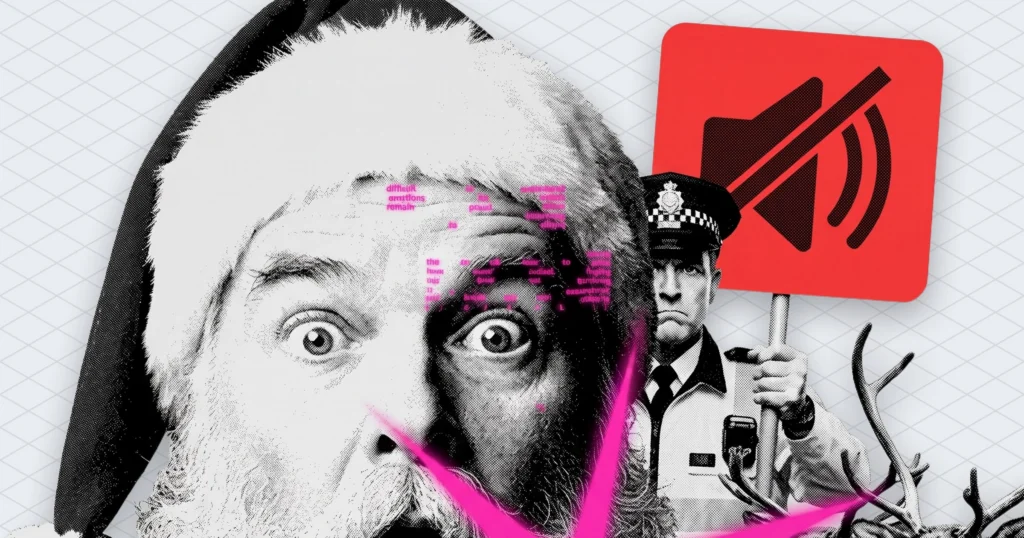
Christmas music for videos is a seasonal trap. The songs everyone wants are either very old and free, or recent and owned by someone with a fingerprinting system and a lot of patience. This post is for YouTubers, TikTokers, small brands and anyone editing a holiday clip in November, when the deadline is close and the music folder is empty. It explains which part of a Christmas song is free. Spoiler: not the part you hear. Then it lists where to find Christmas music for videos that won’t get muted, demonetised or blocked.
Every December it goes the same way. Someone films a perfect gingerbread house time-lapse and drops a crooner’s carol under it. YouTube emails them before the icing has set.
We’ve done it too. Once we uploaded a “definitely ancient” choir recording of a carol, and it turned out to be a re-release from this century, remastered and fingerprinted and very much owned. The claim arrived before the thumbnail finished processing.
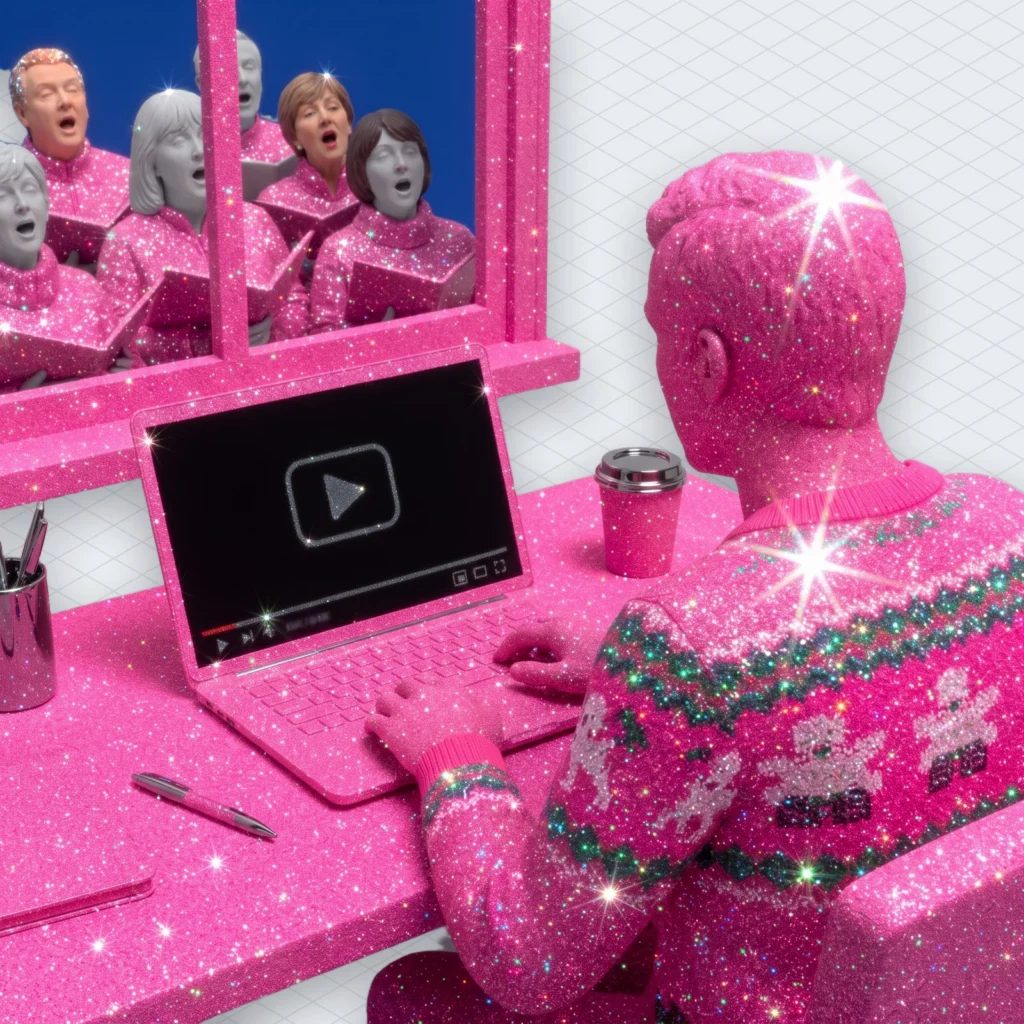
Christmas songs carry two copyrights, and only one of them is old
This rule explains almost every holiday claim. A song isn’t one thing in copyright law. It’s two.
The US Copyright Office treats the musical composition and the sound recording as separate works. Two works. A composition is the melody and the lyrics. A recording is one specific performance of them, captured on one day by specific people. So registering the composition doesn’t cover anybody’s recorded performance of it.
Think of the composition as the recipe. The recording is one particular cake, baked by one bakery in one year with its own oven and its own staff, and the bakery still owns it, crumbs included. Recipes going public domain don’t hand you anyone’s cake.
You rarely see this split. Streaming apps show a song title and an artist, never “composition: public domain, recording: owned by a label since the nineties”. So the one detail that decides your claim is the one nobody prints.
For Christmas music for videos, this split matters more than in any other season. The holiday canon is full of songs whose compositions are free and whose recordings very much aren’t. Choirs, pop singers, orchestras, church groups and session players hired by production libraries record the same 1800s carols every single year, usually in October, while the rest of us are still thinking about pumpkins. Each recording starts a clock. Each one can also have its own rights holder, its own reference file and its own opinion about your vlog.
Arrangements are trap number three. Someone might write fresh harmonies, a new intro and a key change before the last chorus. That arrangement can earn its own protection on top of the public domain melody. Yes, even the key change. So “the song is old” is where you start checking, not where you stop.
Which Christmas songs are public domain in the US in 2026
The US public domain moves forward one year every January. Duke Law’s Center for the Study of the Public Domain reports that works published in 1930 entered the US public domain on January 1, 2026. Recordings from 1925 joined them. Not 1930. 1925.
Recordings run on their own, slower clock. Duke explains that the 2018 Music Modernization Act gives older recordings a 100-year term, which is why 1925 is the cut-off. For anyone picking Christmas music for videos, those two dates are the whole game.
Now the carols. Jingle Bells is the obvious one. A Theatre Survey article notes that Pierpont copyrighted the song in 1857 while living in Georgia. That is far past any copyright term, so the composition is free.
Silent Night is older still. Salzburg’s tourism board dates its first performance to December 24, 1818, at St. Nicholas’ Church in Oberndorf. Joseph Mohr, a Salzburg clergyman, wrote the words. Franz Xaver Gruber, a teacher from Upper Austria, wrote the melody.
A short tangent. The popular origin story of Silent Night involves rodents. Classic FM retells the legend that mice had put the church organ out of action, with little hope of a repair before the evening service. So one of the most covered Christmas songs on earth may exist because of a pest control problem.
Anyway.
The 1930 and 1925 rule for Christmas music for videos
Here is the rule of thumb for US creators in 2026. If a composition came out in 1930 or earlier, you can generally perform it. If a recording dates from 1925 or earlier, you can generally use it. Everything newer needs a licence. Sadly, that covers most of the big-band and pop-era songs people actually mean when they search for Christmas music for videos.
Two caveats keep this honest. First, Duke’s page covers US law only, and other countries count terms differently, often from the composer’s death, so a 1930 song that is free in Ohio may still have protection in Europe.
Second, a compilation might call a track “1925” when it’s really a later remaster or re-recording. Check the real recording date, not the vibe of the crackle.
Then there’s sheet music. A modern songbook edition of an old carol can carry a new arrangement. If you play from it, you might copy that arrangement rather than the original tune. Old editions avoid this. Public libraries keep plenty of them, and libraries are heated, which in December counts as a bonus.
Christmas music for videos gets claimed by matching, not by judgement
This is where the theory meets YouTube. Content ID doesn’t look up a composer’s birth year. It listens.
According to YouTube Help, Content ID creates a claim automatically when an upload matches content in its system. Suppose a label uploaded its 2011 recording of Silent Night as a reference file, and your clip uses that same recording, because it was the nicest one on the playlist. It matches. Gruber’s melody is two centuries old. Doesn’t matter. The match is on the recording, which is exactly the copyright that hasn’t expired.
YouTube also points out that Content ID is its own tool, unlike copyright removal requests, which the law defines. A claim is a match plus a policy. Not a verdict. So you can dispute a claim on genuinely public domain material that you recorded yourself.
That is also why a claim can land on music you did license properly. Annoying. True, though. We’ve written about why a paid licence isn’t proof on its own, and the same logic applies to Christmas music for videos.
One data point from our side. Mubert’s own data, last 28 days: about one in four checks on our copyright checker found a rights holder’s claim on the uploaded track. That’s 26.3%, down slightly from 27.3% in the previous period. Plenty of people find out after they’ve built a whole edit around the song. Some of them on December 24. Checking first costs less than re-editing later, and our guide to the copyright checker shows how it works.
What a Content ID claim does to Christmas music for videos
What happens next depends on the rights holder. Not on you. YouTube says the owner’s settings decide whether a claim blocks the video, runs ads on it or just tracks its views. Sometimes the owner shares that ad revenue with the uploader. Any of those actions can also differ by country, so one holiday video can play normally in one country, run someone else’s ads in a second and stay blocked in a third. (A Christmas miracle, but in reverse.)
If a claim already landed, YouTube offers a few exits. Its help page on removing claimed songs lets you mute just the song or all the audio. You can also trim out the claimed segment, or swap in a different track from the YouTube Audio Library and keep the rest of the edit as it is.
All of these work. None of them is what you wanted for your carefully timed reindeer reveal.
Muting is the worst choice for Christmas music for videos, because the music usually carries the whole mood. A silent gingerbread time-lapse is just someone icing a roof for four minutes. Viewers scroll past.
Five sources of Christmas music for videos that won’t come back to bite
Here are the realistic options, roughly from most effort to least. None of them is magic. Each has a catch, and we list the catch.
Record a public domain carol yourself
If you play or sing Jingle Bells from an old edition of the sheet music, the composition is free. The recording is yours too, because you made it. Legally, this is the cleanest Christmas music for videos you can get.
The catch: talent. You need to be able to play, and you also need to avoid copying a modern arrangement note for note. It takes longer than you think, too, because a two-minute carol recorded at home means twenty takes, one barking dog next door and a lot of quiet swearing at a metronome. (Our sound engineer tried this with a ukulele. The rights were perfect. The tuning wasn’t.)
Use recordings from 1925 or earlier
These recordings are public domain in the US, and they have real period charm. Think crackle, one microphone and a tenor who sounds very far away. That suits a vintage-themed Short. It suits a neon unboxing video for wireless earbuds rather less.
The catch is sound quality and a thin Christmas repertoire from that era. And the remaster problem again. Confirm the date of the actual recording you use.
Use the YouTube Audio Library
YouTube calls its Audio Library tracks copyright-safe and says Content ID won’t claim them. That makes it the easy default for Christmas music for videos on YouTube itself, but if the same clip also goes to TikTok or Instagram, read the library’s terms before you cross-post.
The catch is attribution. If a track uses a Creative Commons licence, you must credit the artist in your description. You also get the same tracks as everyone else browsing the library in December. Your sleigh bells will sound familiar. That’s because they are.
License a track from a stock library
This works for Christmas music for videos if you read the licence. All of it. Check which platforms it covers and whether it includes paid ads or only organic posts. Then check whether the track sits in Content ID and needs allowlisting, which means telling the system your channel has permission so it stops claiming you.
The catch: “royalty-free” means you don’t pay per play. Somebody still owns it. Our post on what sublicensing means explains who can pass rights on to whom.
Generated Christmas music for videos skips the shared shelf
A generator composes the track for your request. So it isn’t sitting under every other gingerbread time-lapse on the platform. That alone avoids the December rush on the same handful of stock tracks. You know the ones.
The catch is that terms for generated Christmas music for videos vary by tool and by plan. Read them the way you’d read a stock licence. If you also make spooky-season content, the same split between composition, recording and licence shows up in our post on Halloween music and its fine print. Different costumes, same lawyers.
Christmas music for videos rarely fits the edit, so cut it to length
Most advice about Christmas music for videos is about rights. Length is the other problem, and nobody warns you about it.
Holiday content comes in awkward sizes: a 15-second product teaser, a 45-second Short, a 12-minute cosy vlog, or a three-hour fireplace stream that someone leaves running on a TV in a dentist’s waiting room. Meanwhile, most tracks run about three minutes. That’s what songs are.
So you fade out a carol halfway through a phrase. Or you loop it four times and hope nobody notices the sleigh bells restart at 2:47. Viewers notice. They may not comment, but the loop wears on them the way a shop’s Christmas playlist wears on staff by December 20. We tried the loop trick once on a long stream. By hour two, the chat had given the sleigh bell a name.
The fix is simple. Start from the length of the video, not the length of the song. Our walkthrough on making music fit your video length exactly covers the editing tricks. If you’d rather skip the surgery, Mubert Render takes a description of a mood, genre, tempo or the video itself, then writes an original track of the exact length you need from samples that human artists uploaded and get paid for. Licence scope depends on the plan. Check the live pricing page before a client project.
A prompt like “cosy Christmas lo-fi with sleigh bells, warm piano” gets you the feeling of the season. It borrows nobody’s recording. That’s the whole point of the two-copyright rule: Christmas music for videos sounds festive because of bells, celesta, brushed drums and a choir pad, not because of one famous recording.
What we’d actually put under a holiday video
Our opinion, after more claim emails than we’d like to admit: stop chasing the famous recording. It’s the one thing in the Christmas canon that someone almost certainly owns and has probably fingerprinted. Its owner has also had decades of practice. You will not outlast them.
Use the old melodies when you want recognition, and perform or source them in a way you control. Pick generated or properly licensed Christmas music for videos when you want atmosphere. Save the chart-topping holiday recordings for your own car, where Content ID can’t hear you.
Brands get a higher bar. A sponsored post or a paid ad usually needs a licence that names commercial use. Permissions written for personal vlogs rarely stretch that far, so read before you pay to boost a post.
The same goes for clips you cross-post. A track that is fine on one platform may sit under different terms on another, and nobody’s licence follows your video around asking for ID.
Back to the gingerbread house from the top of this post. The icing still sets in about twenty minutes. What changes is whether the video around it stays live and earning, or plays silently to nobody in a country you’ve never visited.

 Who we are


