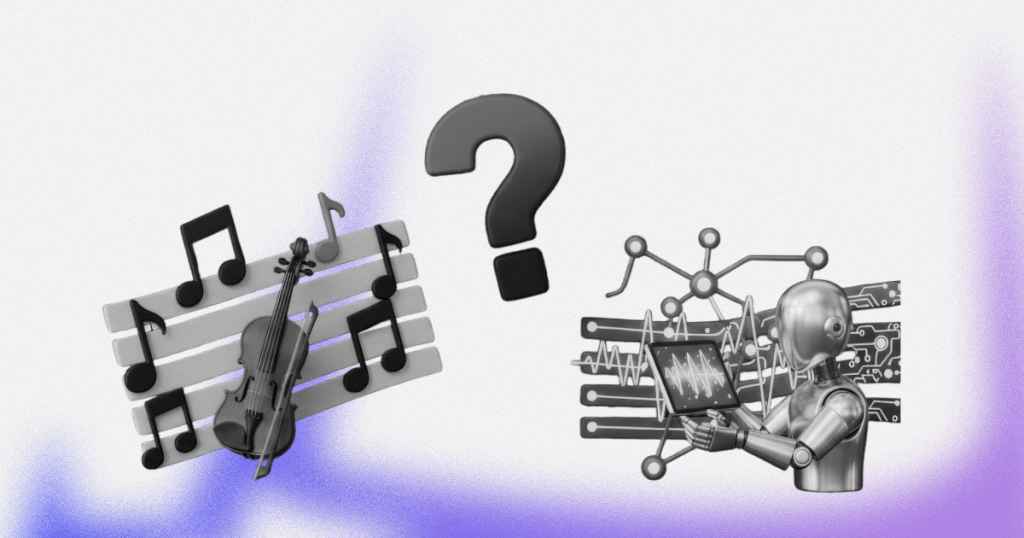
The music industry loves a good disruption story. Electric guitars were going to kill acoustic music. Digital recording was going to replace live musicians. Auto-tune was going to make real singing obsolete. None of that happened, but AI composition feels different somehow.
Understanding AI Music Composition
Instead of being a single piece of software, AI music is built on neural networks trained on massive catalogs of recordings like melodies, rhythms, chord progressions, and even full productions. These systems put together patterns to create something new.
There are two main ways they work:
- Some generate MIDI instructions — basically, the digital sheet music that tells instruments which notes to play and when.
- Others skip that step and generate full audio recordings, sounding like they rolled out of a studio session.
Modern AI tools are simple to use: you should just type in a description, and the system will spit out music in that style. It’s not copying a song from its training set; the AI just reassembles the rules it learned into a fresh output.
The Limitations of AI Music Composition
AI makes it easy to spit out melodies, beats, and even full productions, but it still runs into walls.
It can copy the framework of a style, but it doesn’t explain why a song works. Human composers draw on memories, cultural influences, and lived experiences. That’s why an AI can spit out a convincing “sad piano track”, but it won’t carry the same weight as something written by a person who has actually lived through heartbreak or joy.
These systems learn by chewing through existing songs, spotting patterns, and mixing them into new arrangements. That’s clever, but it’s not the same as inventing something brand new. It also isn’t a collaborator. A human composer can brainstorm with you, try different directions, and refine ideas together. With AI, the interaction stops at “type a prompt, get an output”.
On the technical side, most generators are still limited. They can handle bite-sized loops or a narrow genre focus, yet stumble when asked to build full-length works with evolving arrangements.
How AI Is Impacting Other Creative Fields?
It isn’t just music feeling the pressure of AI. Painters, filmmakers, writers, and designers are all running into the same questions about what counts as original work and where the line between tool and creator should be drawn.
AI generators are used in:
- visual arts to produce studio-grade visuals in no time at all;
- writing and content creation to generate ideas and handle repetitive tasks;
- film and video production to de-age actors, clean up old footage, and generate background extras;
- photography to restore old photos, change lighting, and remove objects instantly.
However, AI isn’t wiping out human creativity. Across industries, it works best as a collaborator, taking care of repetitive or technical tasks and leaving space for artists’ vision, emotion, and storytelling.
Future Prospects
AI in music is moving fast, but it’s still just getting started. Right now, most tools are used to spit out loops, background tracks, or short pieces for content creators. In the next few years, though, we’ll likely see much more significant changes.
- One direction is adaptive sound, or music that shifts in real time based on what’s happening around you. For example, it can be a jogging playlist that matches your pace.
- Personalization will get deeper. Instead of just “recommended for you”, listeners may get tracks written on the fly based on their tastes or even biometric data like heart rate or mood.
- We’ll probably see new ways for artists to monetize their work, maybe through personalized song creation or interactive music experiences.
Of course, there are still big questions. Who owns music that’s generated this way? The user, the company, nobody? Until copyright law settles these issues, large-scale commercial adoption will move cautiously.
The most likely future is a hybrid one. Despite rapid advances in AI, around a third of listeners stick with human-composed songs, citing meaning and emotional depth as their reasons. Even so, AI continues to broaden what musicians and producers can experiment with.
The Unmatched Excellence of Human Composers
AI is getting better at putting notes together, but human composers still have something machines can’t fake. When a songwriter describes losing someone, they’re writing from lived pain. An algorithm, on the other hand, only “knows” that sad songs often lean on minor chords and slower tempos.
The charm of music often comes from imperfections like a guitar buzzing, a vocal that cracks a little. These moments make a track breathe, in a way that perfectly programmed notes never do. Musicians also bring their own culture into the room, shaping songs that speak directly to the people around them.
And when producers meet in a studio, they don’t just follow rules. They jam, improvise, and stumble into ideas no algorithm could have planned. This unpredictability is part of what makes music stick.
Create music with Mubert
Want to try making music with AI? Mubert Render makes it pretty simple, even if you’ve never touched an instrument.
Just type in what you need or upload an image using the image-to-music feature, and the AI does its thing. You can select how long you want it (15 seconds to 25 minutes) and choose between full tracks, loops, or short jingles. Hit generate, wait about 30 seconds, and you’ve got a completely original song.
Every track generated with Mubert Render is royalty-free, so you don’t need to worry about copyright claims or ongoing licensing fees. You can use it in YouTube or Twitch videos, commercials, branded content, podcasts, apps, or games, and personal creative projects.
Mubert has apps for iOS and Android, so you can generate and save tracks on the go. If you’re a developer, you can integrate Mubert’s API into your own app, game, or platform, and generate adaptive, real-time soundscapes that change depending on user interaction.
Conclusions
So, can AI replace human composers? Not really, at least not completely.
AI can create decent beats, generate background tracks, and even mimic specific styles, but there’s still something missing when algorithms try to create art. Human musicians bring real experiences to their songs. They’ve felt heartbreak, celebrated victories, and understood their culture.
The most likely path isn’t AI replacing composers but AI working alongside them. Because the real measure of a song isn’t the process behind it, but the emotion it carries. If it resonates, the tools used to create it don’t matter.


 Who we are