


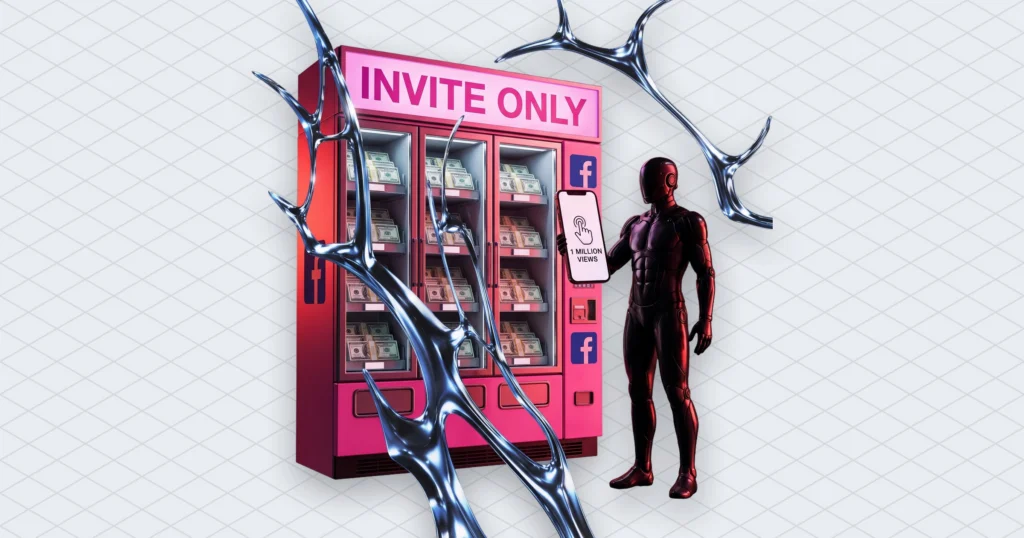
Facebook monetization now mostly means one program. It’s called Content Monetization. It pays for Reels, longer videos, Stories, photos and text posts, and Meta only lets you in if it invites you. Around it sit a few side doors: Stars, subscriptions and a guaranteed-pay deal for creators coming over from other platforms. This post is for anyone on Facebook who wants monetization to mean actual money and needs three things: the requirements Meta writes down, what it pays per 1,000 views, and why nobody can give you that number honestly. (Meta can’t either. It doesn’t publish one.)
The calculator above compares platforms using rates creators report. Treat its Facebook monetization line as a weather forecast. Not a payslip. By the end you’ll know which number in your own dashboard replaces the forecast, and why two creators with the same view count get very different payouts.


Facebook monetization is now one program with a guest list
Until 2024 Facebook paid creators through three separate programs: in-stream ads (ads inside longer videos), Ads on Reels, and a Performance Bonus that paid by views. In October 2024 Meta merged them into Facebook’s Content Monetization program. Three programs, one name. It invited 1 million creators who were already earning to the beta, TechCrunch reported, and promised open enrollment the next year. Meta also said the old programs would close once the beta ended.
So if you remember a follower-and-minutes threshold from older guides, that was the in-stream ads era. It’s gone. New creators get pointed at an interest form instead.
In March 2025 Facebook added Stories to Content Monetization. Creators already in the program got Stories earnings automatically, according to TechCrunch, and a spokesperson said there was no minimum number of views before earnings started. Open enrollment was still described as coming “sometime in 2025”.
Then 2025 ended. In March 2026, Meta’s own creator blog still called the program invite-only. You can’t apply. You can raise your hand: Professional Dashboard in the mobile app, then the Monetization tab, then Content Monetization, then the interest form.
It’s a nightclub. The bouncer has a clipboard, the clipboard has no rules printed on it, and you fill in a form saying you’d love to come in.
Facebook monetization requirements Meta actually publishes
We spent an embarrassing afternoon looking for Meta’s follower threshold for Content Monetization. We read the creator pages, the help pages and the announcements. Then we read them again, slower.
There isn’t one.
Meta’s pages for the main Facebook monetization program list no follower count, no watch-time target and no minimum number of posts. Plenty of sites will give you a number anyway. They disagree with each other, and none of them link to a Meta page. Ignore them. Ask any guide quoting a follower count for its link to Meta. You won’t get one.
Here is what Meta does put in writing. You need a Facebook Page or a profile in professional mode (the creator setting that switches on the Professional Dashboard). Your content has to follow the Community Standards and the Partner Monetization Policies, which is Meta’s rulebook for who gets paid. The subscriptions page adds a detail that applies across Meta’s paid tools: a Facebook Page that has never used one of Meta’s monetization products goes through a Page-level review first. Meeting a product’s own requirements doesn’t skip that step.
One door skips the queue entirely. Creator Fast Track, announced by Meta in March 2026, gives established creators from other platforms immediate access to Content Monetization. That access stays on after the program ends. Money later.
Facebook’s originality rules can switch monetization off
Meta also cares about originality, and since July 2025 it has said so loudly. It announced a crackdown on “unoriginal” content, Tubefilter reported. Accounts that keep reposting other people’s work without adding anything can lose Facebook monetization for a while. Worse, they get less reach on everything they post. Even the original stuff.
Reactions, commentary and trends are still allowed. Reuploading someone’s viral clip with a new caption is not.
The line is fuzzier than creators would like. A reaction video adds something. A compilation of twenty strangers’ kitchen fails with your logo in the corner probably doesn’t, however long the logo took. If you’re unsure, ask whether a viewer gets anything from your version that the original didn’t give them. If the honest answer is “a watermark”, that’s a no. Watermarks aren’t content.
What counts as a qualified view on Facebook
This section explains most of the “I got a million views and earned lunch money” posts.
Meta pays on qualified views. Not views. In its March 2026 post, Meta lists twelve reasons a view doesn’t qualify for Facebook Content Monetization earnings. Some are obvious. Others will quietly eat a Reel’s earnings if you don’t know about them:
- content shorter than 10 seconds
- a viewer who left before 5 seconds
- repeat views by the same person in one session
- posts that aren’t public
- views from before your payout account was set up, while earnings were paused
- earnings on hold during a copyright claim review
- views from restricted users
- content posted from a Page or person you don’t own or manage
Run your own Reel through that list. A 9-second loop that people watch twice loses on two counts. Too short. Repeat view. Borrow it from another Page and it loses on a third, which at this point is almost an achievement. The view counter still shows a big number, because Meta is simply counting something else.
Social Media Today summed up the rest of Meta’s advice: test formats, post original work, and skip engagement bait like “watch till the end” unless the ending pays off. Meta also says watch time, engagement and content quality affect earnings. Nobody outside Meta can measure those three for your video. Not even you, fully.
Facebook monetization rates per 1,000 views: Meta publishes none
Meta publishes no rate. Not per view, not per 1,000 views, not per Reel. YouTube creators get a revenue-share percentage in their terms, while Facebook monetization comes with a dashboard instead.
Meta does publish totals. It says it paid creators nearly $3 billion in 2025, 35% more than the year before. About 60% went to Reels and the rest to Stories, photos and text posts. The number of creators earning more than $10,000 a year grew by over 30%, per Meta’s announcement. None of that tells you what your next 1,000 views are worth, because a big pot split among a very large number of creators can still mean small spoons.
The closest thing to an official Facebook monetization rate arrived in March 2026. Meta added a metric called Earnings Rate to the Professional Dashboard. It shows your approximate earnings per 1,000 qualified views, worked out after the fact for your own audience. Nobody else’s. Think of a restaurant that prints prices only on your receipt.
So read it as a trend, not a promise. Compare it week to week, and give it a few weeks before you panic, because one viral post from the wrong country can drag the whole average down. If your dashboard lets you split earnings by format, put Reels, longer videos and Stories side by side. When the rate drops right after you changed length, music or posting time, you have a clue no outside blog can give you.
What creators report earning per 1,000 views
Creator reports from reputable press are rare, and the best ones are old. In February 2023, Fortune spoke to Reels creators during the bonus era. One said she had earned as much as $24,000 in a single month in 2022, then watched her payments fall to around $6,000 a month. Another made about $110 a month while his content reached 4.1 million users over 90 days. Six creators with at least 100,000 video views a month reported anywhere from $0 to $6,000 a month. Zero to six thousand. “I don’t really know how it works,” one of them said.
That was the old bonus program, and reach isn’t the same as views. So don’t divide one number by the other and call it a rate. We tried. It came out at a few cents per 1,000, which proves only that we own a calculator.
Anyway, the rates you’ll find online today mostly come from blogs quoting other blogs. Cents to dollars per 1,000. Few say which program, which country or which format they mean, and those three things explain most of the spread. Ad money depends on where your viewers live, long videos with ad breaks get paid differently from short Reels, and qualified views can be far fewer than the number under your video.
If you want to see Facebook monetization next to other platforms, our short video earnings calculator puts them side by side. Useful for scale. Then open your dashboard and swap the estimate for your own Earnings Rate once you have one.
Other Facebook monetization tools: Stars, subscriptions, Fast Track
Content Monetization pays you for what people watch. The other three pay you for who’s watching. Their rules can actually be read, which after the last two sections feels almost generous.


Stars pay one cent each
Stars are a tip currency. Fans buy them and send them during live videos, Reels and other posts, and Meta pays the creator one cent per Star. To turn them on, your Page needs at least 500 followers for 30 consecutive days. You also have to live in a country where Stars are available, follow the Community Standards and the Partner Monetization Policies, and agree to the Stars terms.
One cent per Star is the only fixed rate anywhere in Facebook monetization. It’s also the smallest coin in the room. Ten thousand Stars is $100. So Stars suit creators who go live with a small, loyal crowd, where a hundred regulars tipping now and then beats a million strangers scrolling past.
Subscriptions need followers and activity
Subscriptions let fans pay you monthly for extras. Meta’s page sets two bars. First, your Page needs 10,000 followers or more than 250 return viewers. Second, in the last 60 days it needs either 50,000 post engagements or 180,000 minutes viewed. The feature is open in a list of countries that includes the United States, the United Kingdom, Canada, India, Brazil and Germany. Elsewhere, invite-only again.
The return-viewer clause matters more than it looks. A small Page whose people keep coming back can qualify long before 10,000 followers. It’s the one place where Facebook’s monetization rules reward a loyal audience over a big one.
Creator Fast Track guarantees pay for three months
Fast Track is Meta recruiting creators from TikTok, YouTube and Instagram. Creators with at least 100,000 followers on one of those platforms can get $1,000 a month for three months for posting eligible Reels on Facebook. Above one million followers, it’s $3,000 a month, TechCrunch reported. Participants also get more reach on eligible Reels and immediate access to Content Monetization.
Three months is a trial, not a salary. Plan month four before month one starts, because that’s when your pay goes back to whatever your Earnings Rate says.
Availability depends on your country. When we opened the program page from outside the launch markets, it said it wasn’t available there yet. Check it from your own account before you build your Facebook monetization plan around it.
Facebook monetization and music: claims freeze the money
Back to the list. One reason a view doesn’t count was “earnings on hold due to copyright review”. While a claim on a video is reviewed, its views don’t earn. If the claim holds, the rights holder can collect what that video makes instead of you. A claim doesn’t always mean you did anything wrong, either. Sometimes the track was licensed and the claim is a mistake, and you still wait out the review with the earnings frozen.
Most creators pick music by vibe and check the licence never. We’ve done it too. We put a “free” track on a test video, got a claim, and learned the hard way that the person who uploaded a free track and the person who owns the recording aren’t always the same person. The video kept playing. The money didn’t.
It happens more than you’d think. In Mubert’s own data from the last 28 days, about one in four results from our copyright checker found a rights holder’s claim on the uploaded track. That’s 26%, down slightly from 26.8% the period before. These are tracks people were already worried enough to check, so it isn’t a rate for the whole internet. Still, one in four is a lot of frozen Reels.
How to keep music from freezing your earnings
The fix is boring. Check the track before you post, not after the claim. Our guide to checking Facebook videos for copyright shows how to test a finished video. Or skip the shelf. Mubert Render composes an original track to the exact length you need, from samples that real artists uploaded and get paid for. It’s cleared for commercial use under the platform licence, but the exact scope depends on your plan, so read it once.
Rights and originality collide. A Reel built on someone else’s clip and someone else’s song breaks two rules at once. Even with views, it may never see a cent of Facebook monetization.
A checklist for Facebook monetization this week
- Switch to professional mode.
- Fill in the Content Monetization interest form in the Professional Dashboard, even though nobody will tell you when anyone reads it.
- Set up your payout account today.
- Make every Reel at least 10 seconds long.
- Give viewers a reason to stay past the fifth second, because a view that ends before then doesn’t count at all.
- Turn on Stars once your Page has had 500 followers for 30 straight days.
- Check your music before posting.
- Replace the calculator’s estimate with your own Earnings Rate once the dashboard shows it.
Do all eight and you still won’t know Meta’s rate. You’ll know yours, printed on the receipt like everything else in that restaurant.



 Who we are


