 is live now • Soundtrack your videos

 Home
Home

Twenty-two weeks. That’s how long one podcaster spent fighting a podcast music copyright claim on a track they had paid for.
Their show had been running over four years. Clean rating, 4.7 stars on Apple Podcasts, 5 on Spotify. The music came from a mainstream stock library — bought, licensed, invoiced. When the claims started, the library’s advice was to file a dispute every week and keep filing. Its explanation was that this happens when the artist behind a track wants to keep control of where it runs.
They eventually gave up and swapped the music out — after five months of a process that was supposed to take days.
If you’ve ever assumed that buying a licence is the end of the story, that case is the whole argument in one paragraph. This guide covers what a podcast music copyright claim actually tests, what you need to be able to produce, and the sequence to work through if one has already landed.
The short version: a licence is what you bought. A record is what you can hand over. Most podcasters have the first and cannot produce the second.
What does a podcast music copyright claim actually test?
Not whether you paid. That’s the part almost everyone gets wrong.
A licence is a permission and a claim is an accusation, and they’re handled by different systems, in that order.
Automated content matching runs first. It compares your episode’s audio fingerprint against a rights database and flags what it thinks is a match. Your invoice isn’t in that database, so nothing about your purchase is visible at this stage. Only afterwards, when the claim already exists, does a human process start. That’s the point where your paperwork matters, and it’s the only point.
In the case above, both of these were true at the same time: the library had the right to sell the licence, and the artist had retained the right to enforce. The podcaster sat in the gap between those two facts for five months.
Where it fails: the weak link was never the licence. It was that nothing they held ended the argument in a single exchange.
What do podcasters actually argue about when music comes up?
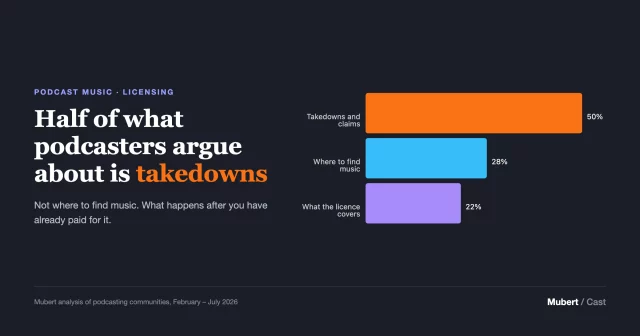
Takedowns, more than anything else. We analysed six months of discussion across the largest podcasting communities — every thread where music was the subject. Half of it was about claims and takedowns. Just over a quarter asked where to find music at all, and the remainder asked what a licence actually permits.
That split is worth sitting with, because it’s the inverse of what gets written. The internet is full of guides on where to get podcast music — we’ve written one of them — and comparatively little on what happens after the download. The anxiety is concentrated at the wrong end from the content.
Honest caveat: this is our own read of six months of public discussion, not a survey. It tells you where the noise is — not how common claims are in absolute terms, and not how many get resolved quietly without anyone posting about them.
What proof does each source of music leave you?
Every way of getting music leaves you holding a different kind of evidence. Most podcasters have never checked which kind they have.
Here’s the part that stayed with me. When that podcaster asked other podcasters what to do, half the replies recommended a different stock library. The other half scattered across hiring a composer, using a free library, and a vendor recommending itself.
So the most popular fix for a stock-library claim was a different stock library, and not one reply questioned the mechanism that had produced it.
If the terminology itself is where you’re stuck — royalty-free, copyright-free, public domain — that’s a separate untangling, and we’ve done it in royalty-free vs copyright-free music.
What must a music licence record actually contain?
A useful record answers, in one document, every question a platform’s appeals form is going to ask. Most people have never opened theirs, so here’s the checklist.
A licence record should name:
- The specific track — a title or identifier matching what’s audible in the episode, not the name of your plan.
- The specific episode or project it was cleared for.
- The date it was issued, so it can be shown to predate publication.
- The scope of use — podcast distribution, monetisation, sponsor reads, social cutdowns. Scope is where most disputes are actually decided, and it’s the field people skip. A track cleared for “podcast use” and a track cleared for “podcast use including host-read sponsorships” are different permissions, and the second one is the one an advertiser’s lawyer asks about.
- The issuing party, with some way to verify the document is genuine.
- The territories and duration, where either is limited.
The document itself isn’t the licence, and it’s worth being precise about that. As we’ve argued elsewhere on this blog, licensing is a rights system rather than a file — terms, boundaries, a sublicensing path, and a verifiable record of who owns what. The record is simply the visible end of that system: the part you can attach to an email on the day a claim lands.
Which is exactly why it needs to be near the episode rather than in a vendor portal you last logged into eight months ago.
Test it in thirty seconds. Open the last episode you published. Can you produce a document naming that track in that episode? If what you find is a subscription receipt, you have proof of payment — not proof of permission.
What is a clearlist, and why has nobody told you about it?
A clearlist — some platforms call it a whitelist — is a pre-emptive registration. The rights holder tells the content-matching system that your show is authorised to use a given track, before any claim is generated. It’s the difference between winning an argument and never having it.
It’s also why some podcasters never meet this problem. They asked their library to clearlist the show, the library did it, and the flags stopped.
Two things worth knowing. Clearlisting is offered by some libraries and not others, and it’s usually something you have to request rather than something you get by default — so it’s a question to ask before you subscribe, not after your first claim. And it’s per-platform: a YouTube clearlist does nothing for a podcast host.
What should you do if you already have a claim?
Work in this order. The first two steps are time-sensitive and the last one isn’t — most of a podcast music copyright claim is decided by what you do in the first hour.
- Screenshot everything before you touch it — the notice, the claimed timestamps, the episode as published. Some interfaces stop showing the original notice once a dispute is open.
- Find the strongest document you hold for that specific track and check whether it names the episode. If it doesn’t, say so plainly in the dispute rather than hoping nobody notices.
- File once, completely. A dispute rejected for missing information usually restarts the clock, and the clock is the punishment.
- Ask the library to clearlist you for that track, in the same message where you report the claim.
- If the answer is “resubmit weekly”, treat that as information. In the case above, that instruction consumed five months. A library that can’t clear its own catalogue on your behalf is telling you something about the catalogue.
- Change the music on new episodes while the old dispute runs. The back catalogue and the next release are separate problems, and solving the second doesn’t require winning the first.
How does Mubert Cast handle this?
Here’s what every option in that table has in common: you’re assembling evidence after the fact, from whatever the source happened to give you.
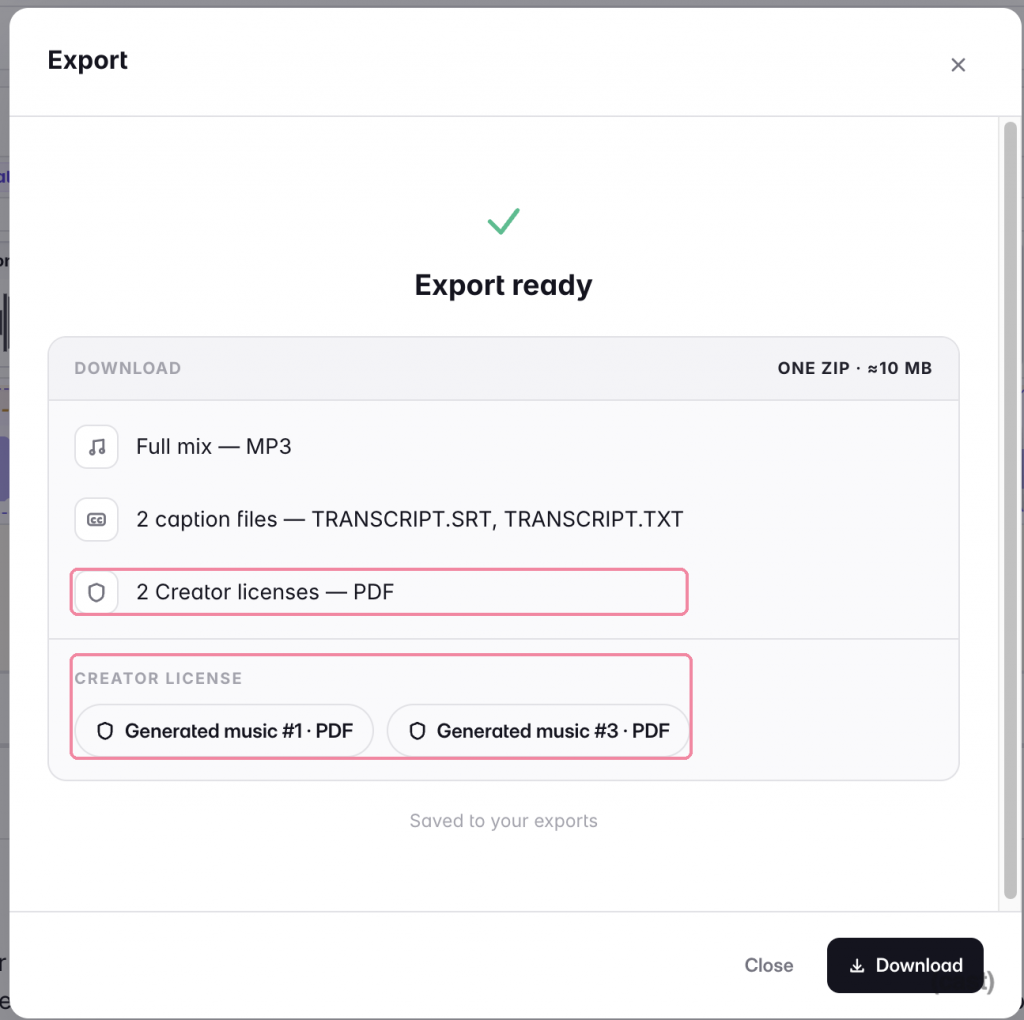
Mubert Cast generates original music inside the episode and attaches a licence record to the export itself. Three things follow.
- The track is original, so there’s no catalogue entry to match against. Automated matching works by comparing your audio to a database of existing recordings. Music generated for your episode isn’t in one.
- The record travels with the file, not the account. Every export made on a licensed plan carries its own, and past exports stay downloadable with their licence files attached — so the thirty-second test above has an answer that doesn’t involve a vendor portal.
- The underlying samples come from paid human musicians. That’s the honest answer to the sharpest objection to generated music: if a model has no rights to what it learned from, any licence built on top is worth nothing.
Honest caveats, because this is a subject where overclaiming gets punished in public:
- A licence record does not make a claim impossible. Nothing does. It changes how long you spend proving your case — from months of weekly resubmissions to one attachment.
- Commercial licensing is on the Plus and Max plans. Free and Lite have no commercial licence, so a monetised show shouldn’t publish from them. The licensing docs set out what’s covered where.
- Music you upload yourself is yours to clear. Cast doesn’t license third-party audio you bring in.
- The record covers the export. Content ID registration or a standalone music release is a different licence and a different conversation.
Finish an episode with the paperwork attached
Mubert Cast generates original music inside your episode and attaches a licence record to every export on a licensed plan. Editing, transcription and export never cost credits.
Frequently asked questions
Does a copyright claim mean I did something wrong?
No. A podcast music copyright claim is an assertion by a rights holder or an automated system, not a finding. The case above involved a properly purchased licence and still ran twenty-two weeks.
Will a licence stop my episode being pulled?
It won’t prevent the action. It shortens the argument afterwards. Any tool promising immunity from claims is describing something that doesn’t exist.
Is music from a free library safe for a podcast?
It depends on scope, which is where free libraries catch people. A track licensed for use on YouTube is licensed for YouTube — not automatically for a podcast feed, a client’s channel, or an ad read. Creative Commons tracks are free but frequently require attribution in every episode description, permanently — the CC BY 4.0 deed requires that you “give appropriate credit, provide a link to the license, and indicate if changes were made”, and the licensor can’t revoke that while you’re using the work.
What’s the difference between a licence and a licence record?
The licence is the permission. The record is the evidence that the permission covers this track in this episode, issued on a date you can point to. Most podcasters have the first and can’t produce the second.
Can I get a claim removed retroactively from old episodes?
Sometimes, through the same dispute process — but each episode is usually handled separately, which is why a back catalogue is expensive to fix and cheap to protect.
Bottom line
A licence you bought is a transaction. A licence you can produce, naming the track and the episode, is a defence. They’re not the same object, and the difference only becomes visible on the day a notice arrives — which is the worst possible day to find out.
A podcast music copyright claim is not a verdict on whether you did the right thing. The podcaster who lost twenty-two weeks did everything the standard advice says to do. They used a reputable library and they paid. The advice wasn’t wrong, it was incomplete: it stopped at where to get music and never reached what to keep on file.
Go and check your last episode. If what you can produce is a receipt rather than a record, that’s fixable now, and much harder to fix later.
Method. The twenty-two-week case is a public account posted by the podcaster in March 2026 in one of the large podcasting communities, read in full along with all twelve replies — that thread is also where the reply breakdown in the second chart comes from. The split is our own count across six months of reading those communities, not a survey; we’ve flagged its limits where it appears. Licence and plan details reflect Mubert Cast as documented on 30 July 2026. Figures were checked on that date.

AI Music Company
Mubert is a platform powered by music producers that helps creators and brands generate unlimited royalty-free music with the help of AI. Our mission is to empower and protect the creators. Our purpose is to democratize the Creator Economy.